
|
|
|
The book is available for download on your iPhone, iPad, iPod touch, any other e-book readers and on your computer. |
|

$1.99 |
 from iBookstore, and BARNS & NOBLE
All animals are connected with each other somehow. Although it is not always welcome relation, they interact with in nature anyway. Little Bumblebees come across various creatures in this story with many illustrations. Let’s find out circle of life in nature through the seasons of Bumblebees. |

|

Jack the Lizard is on YouTube |
|
In order to enjoy the animals in the zoo, it is very important to understand the nature of wildlife, their survival and their environment. On this page, Jack the Lizard shows images created from many different information sources. |
There are more stories! |
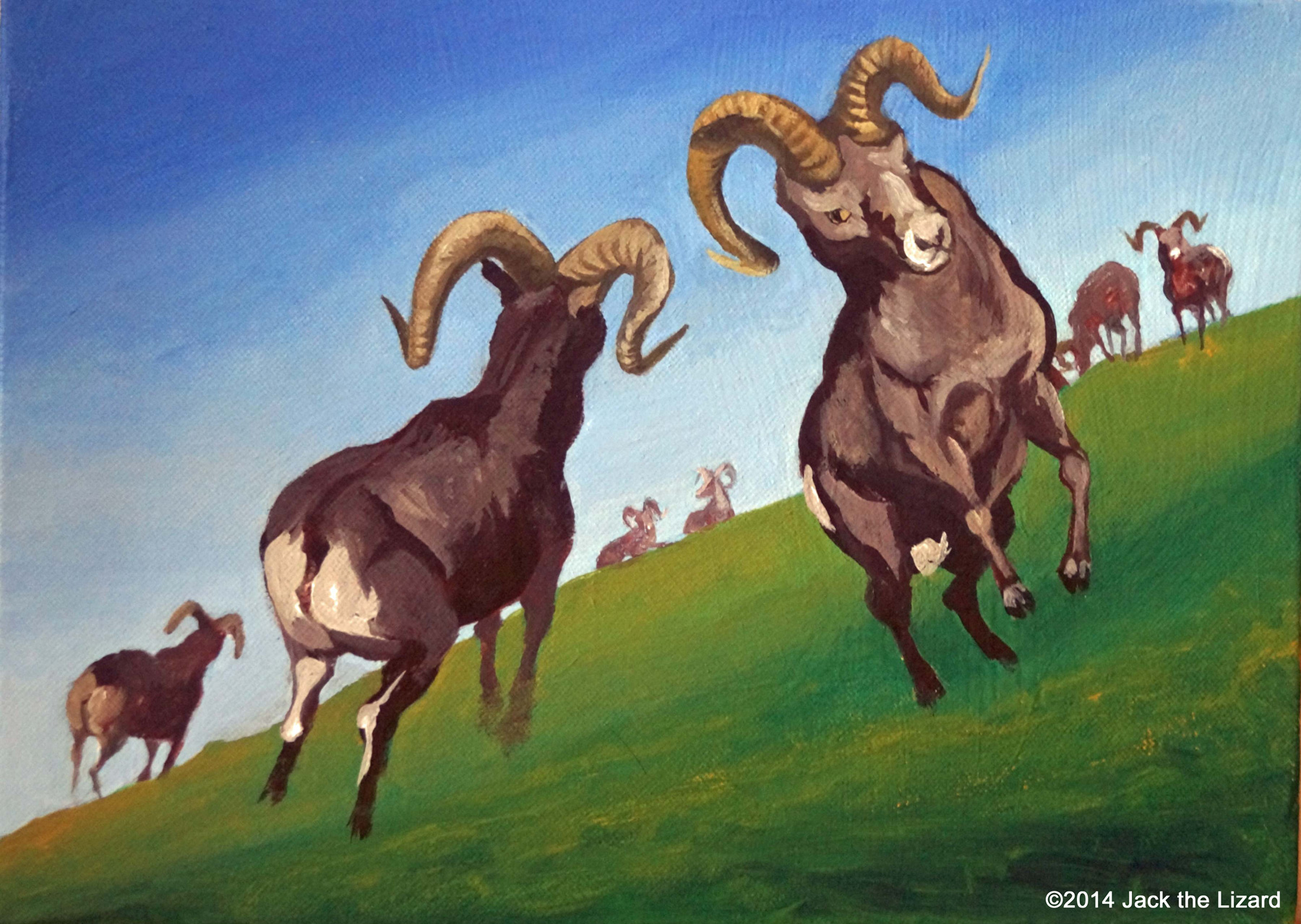
Crush of the Horn - Bighorn Sheep -
|
|
Bighorn sheep live in the mountain area from Western Canada to Northern Mexico. Males have large horns to fight against rivals during the fall and winners get their opportunity to mate. However usually males and females live separately, bachelor males live together and female live in a flock with other females and young. Many images of bighorn sheep were depicted on Petroglyphs in U.S. Since some of them are more than 10,000 years old, first people to enter the American Continents already had hunted bighorn sheep. Sheep have different namesSheep have different names such as ram and lamb. Ram is an adult male with the genital and without called wether. Lamb is a young sheep or meat of young sheep. An adult female sheep is called ewe and give a birth to a baby each year. Sheep meats have also different terms such as mutton and hogget. Mutton is the meat of a female or wether. Hogget is the meat from either sex between one and two years old. They are one of the earliest domesticated animals. Although pork, poultry, and beef are eaten mostly worldwide, sheep meat is still important meal for countries such as Mongolia, Turkmenistan, Iceland, and New Zealand. |
|
Hunting Carnivore
|
|
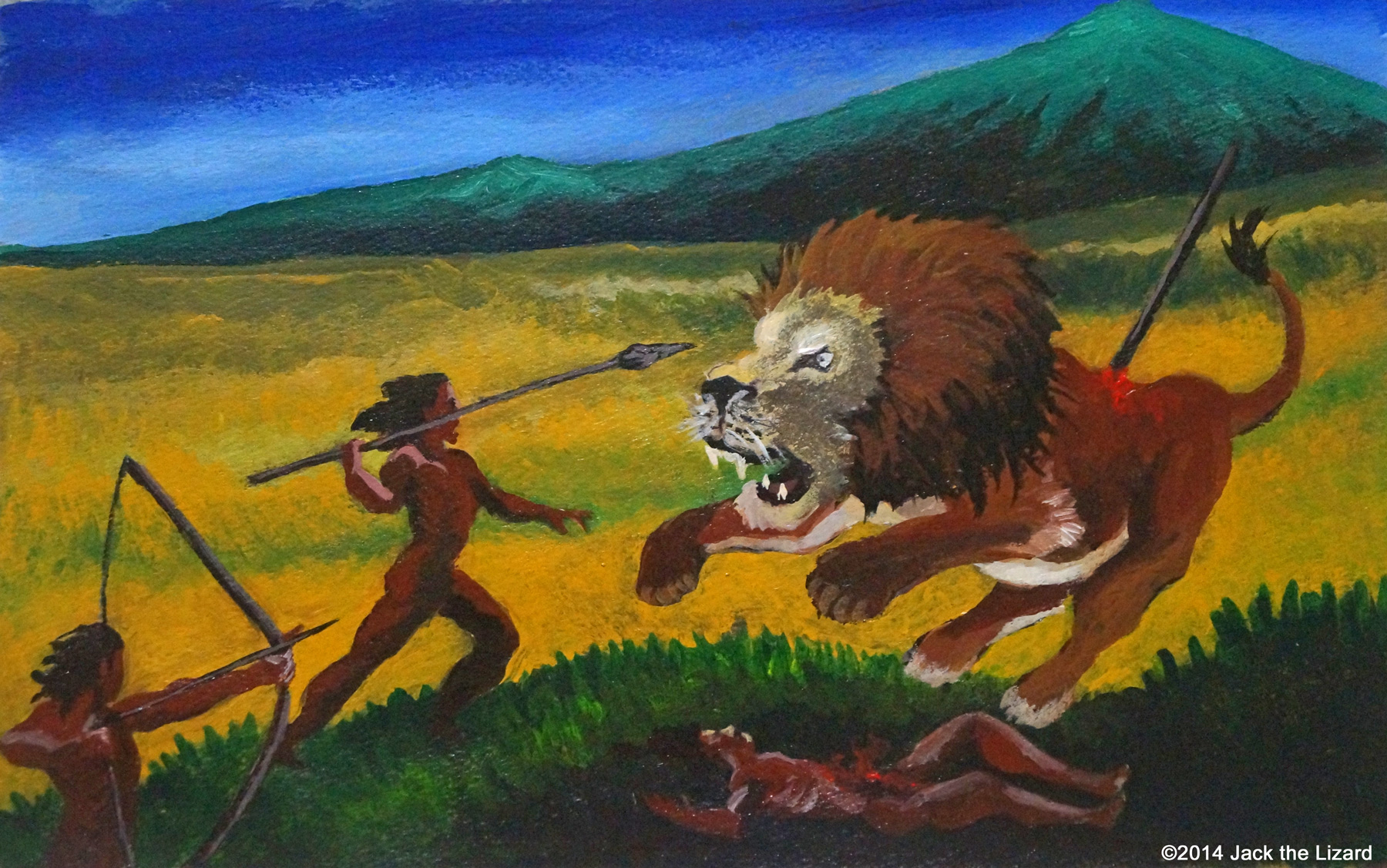
The early humans, Homo Heidelbergensis, might have had killed and eaten lions. The fossils found in Sierra de Atapuerca, Spain show the evidence that Heidelberg Man might have had cracked bones of the European Lion and eaten its intestine. The remains of lions were 300.00 to 350.000 years old. It is still possible that Heidelberg Man had not killed the lion but found dead one or other animal had killed it. However usually if other animal killed the lion, the intestine should have had long gone before Heidelberg Man had found the corpse. The European Lion or cave lion was larger than todays’ African Lion and hunting it was extremely high risk for Heidelberg Man to take. So probably the lions and other predator were not usual prey item for the early humans, however the early humans and predator might have had competed with each other for preys or pro10bably humans were one of the prey for predator. Today the Maasai people in southern Kenya do traditional lion hunting. Warriors of Maasai must show their bravery through lion hunting; only a spear and shield are in their hands. Since lion hunting is strict rites, it is conducted by the rules. Lion hunting is Not sport hunting. The Maasai people recognize that loins have important roles in the ecosystem of savanna. Usually a female is not hunted, but if the one threating livestock will be hunted. Lions are remarkably smart animals and they have advantage in bush against humans. Therefore the warriors fight a lion at open field. Hunting is not always successful and the warriors would lose their life. The warrior who successfully brought down a lion is highly respected and whole community cerebrate his deed throughout his life. He keeps lions’ mane and tales for the award. |
|
Hunting Begun
|
|
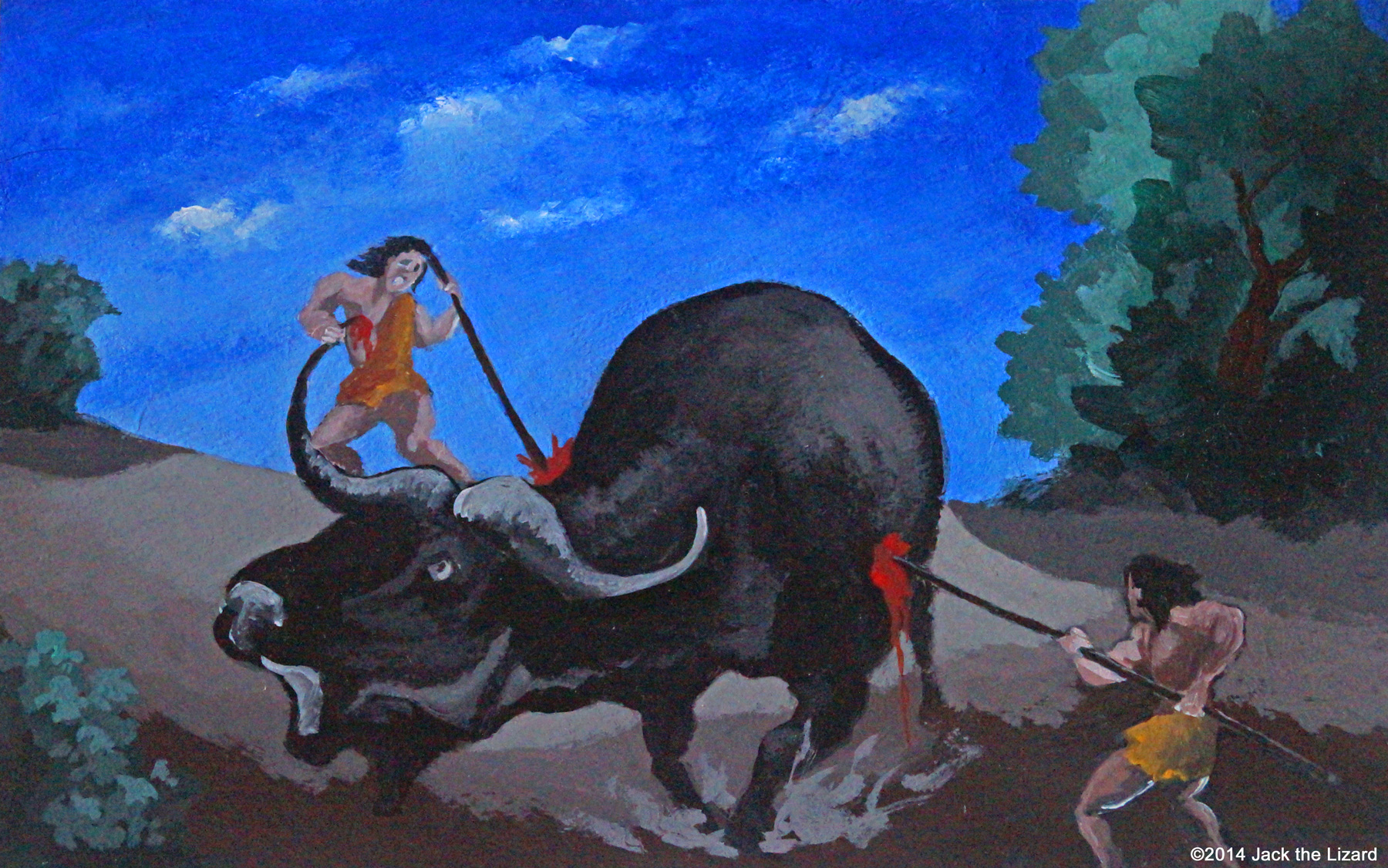
Modern humans are derived from one of Homo species. In prehistoric day there were many Homo species other than Homo sapiens. Although they had thrived at one time, all of them had gone extinct except Humans. The present we are able to acquire enough protein from vegetable products such as tofu and quinoa. However in ancient time before agriculture had begun species of Homo had to do hunting to obtain proteins from meat. The wide range of animals from large game to fish had been hunted with many sorts of weapons. Earlier human species had been using wooden spears around 400,000 years ago. Then Neanderthals had made stone spear heads during the Middle Pleistocene about 300,000 years ago. Since prehistoric hunting was absolutely based on the necessity for dairy life, every body parts of animals from bones to skins were consumed. Today some people in Africa and the Amazon still keep this life style. The early homo species had developed many of effective tools such as the club, arrow, and axe for hunting. They usually hunt together to bring down the large prey. Since the collaboration of dogs had begun, hunting strategies had diversified. Then early homo species had increased their population and spread their range world over. However hunting sometimes had played major role of the mega fauna extinction in some regions such as Australia and North America. |
|

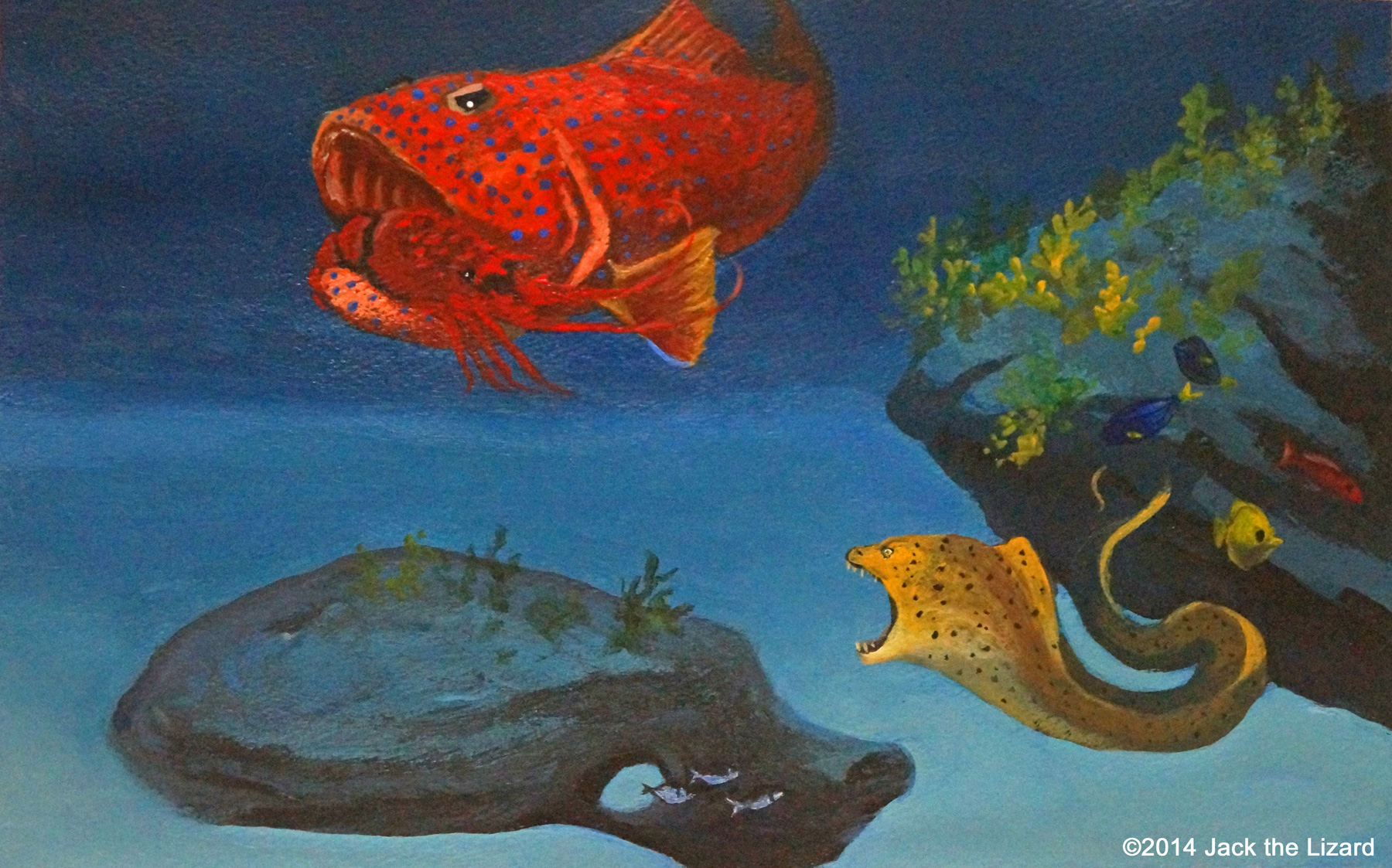
Cooperative Hunting - Roving Coralgrouper -
|
|
Roving coralgroupers sometimes do cooperative hunting with moray eels. Coral groupers shake its body to invite the moray eels to join hunting. Their prey such as octopuses and lobsters are usually hiding in the crevices and beneath the corals. Those places are out of reach for coral groupers. When coral groupers find the place in which the prey is hiding, they point that place and wait for help. Flexible body makes moray eels to slide themselves in the crevices and chase the prey out , but they are not fast enough to catch fish in open water. Coral groupers then act their part, since they are able to accelerate swim speed quickly to grab escaping prey. Moray eels also joint hunting with the humphead wrasse. Inter species team play is also found among the coral trout and octopuses. The coral trout play the part of coral groupers and octopuses play as moray eels. |
|
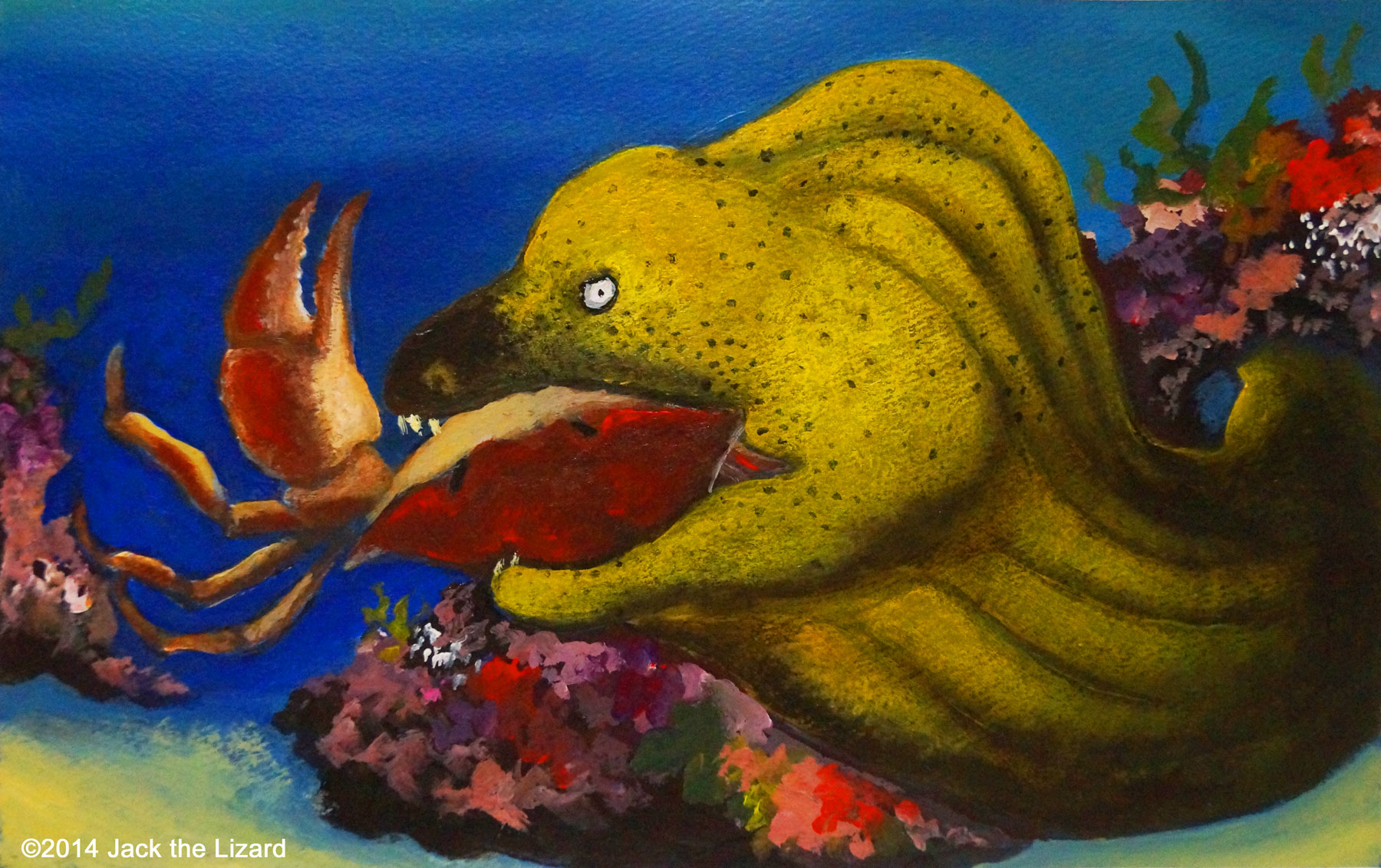
Two Jaws Predator - Giant Moray Eel -
|
|
 Jack the Lizard |
The giant moray eels live in the oceans of the Indo-Pacific region. They hide and swim around coral reefs or rest in rock crevices during the day. The size reaches up to 9.8ft (3m) in length and no other moray eels grow up long like this. Hunting sets on during the night. They eat fish, lobsters and octopuses. Even smaller eels are consumed by them. Moray eels including giant moray have second jaws at the back of their throats. First they hold a prey with their first jaws then pull it back to their throat by using second jaws. They are only animal who has second jaws in the world. Although the giant moray eels are very shy animals, they will attack humans when they are provoked. The forth of their bites are so strong that it is no easy to pull them off, once they garb flesh. Also their meat includes strong toxic substance which could cause human death if it was eaten. |
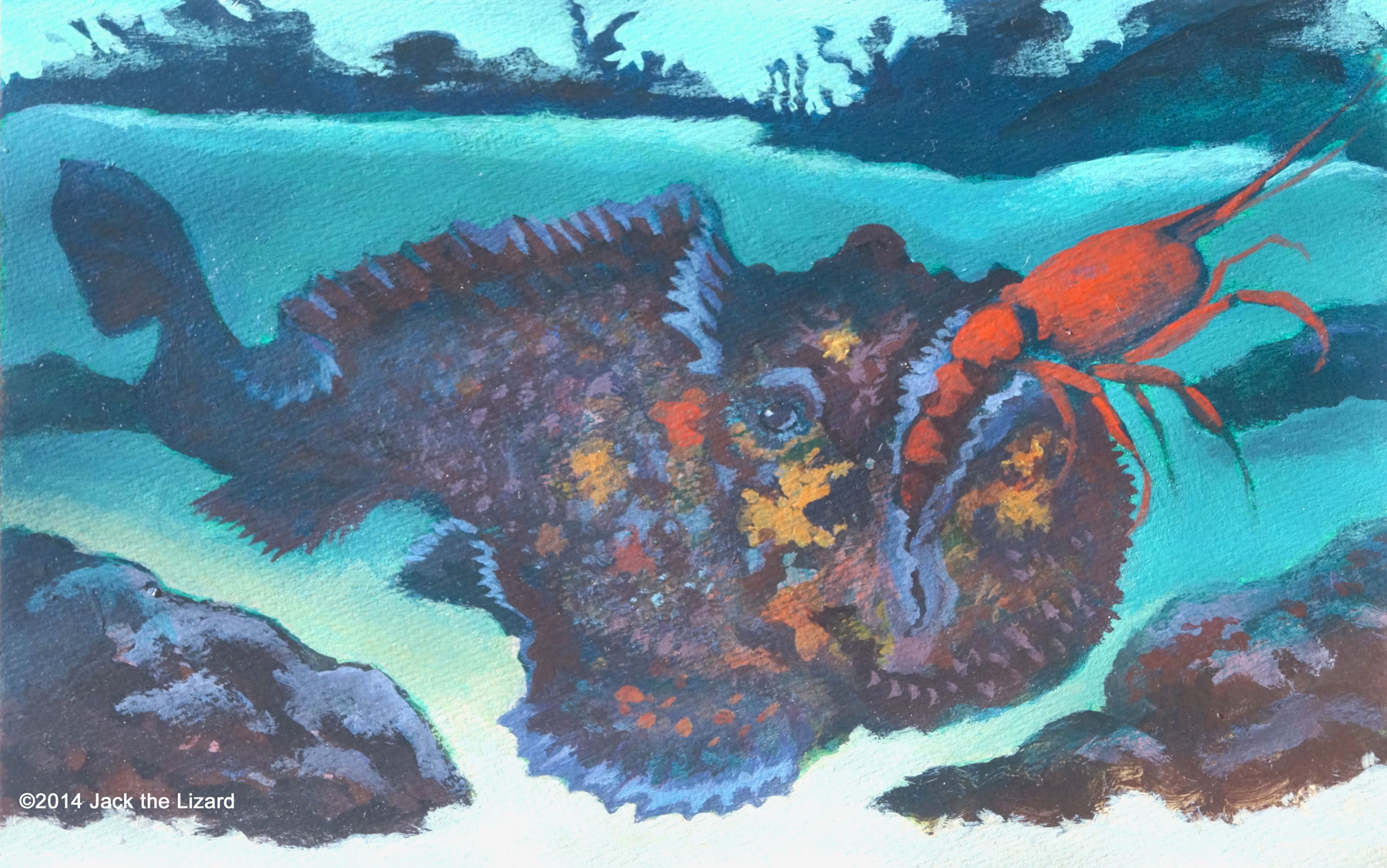
Not Jabba the Hut - Stone Fish -
|
|
More than 1200 species of fish have venom. The stone fish is one of the most dangerous venomous fish. Stone fish range over shallow tropical water in the world oceans. As they disguise themselves as a rock to catch prey, they live in coral reefs or rocky places. The preys are small fish and crustacean such as crabs and shrimps. The venom is in their dorsal fin. It is highly toxic and can be lethal to humans. If the large amount of venom was injected into a body, it causes several effects such as severe pain, paralysis, and tissue death. The affected part should be washed by water and treated with antivenom as soon as possible. The size is about 18in (40cm). The body does not have scales but is covered with thick rugged skin. Not like sea snakes or the lion fish they use their venom defensively. Therefore stone fish do not actively attack humans, but victims have stepped on them accidentally. It is so hard to find them even with experienced eyes, because they blend well into corals. If dorsal fin was carefully removed, they are edible as sashimi or deep fried fish. |
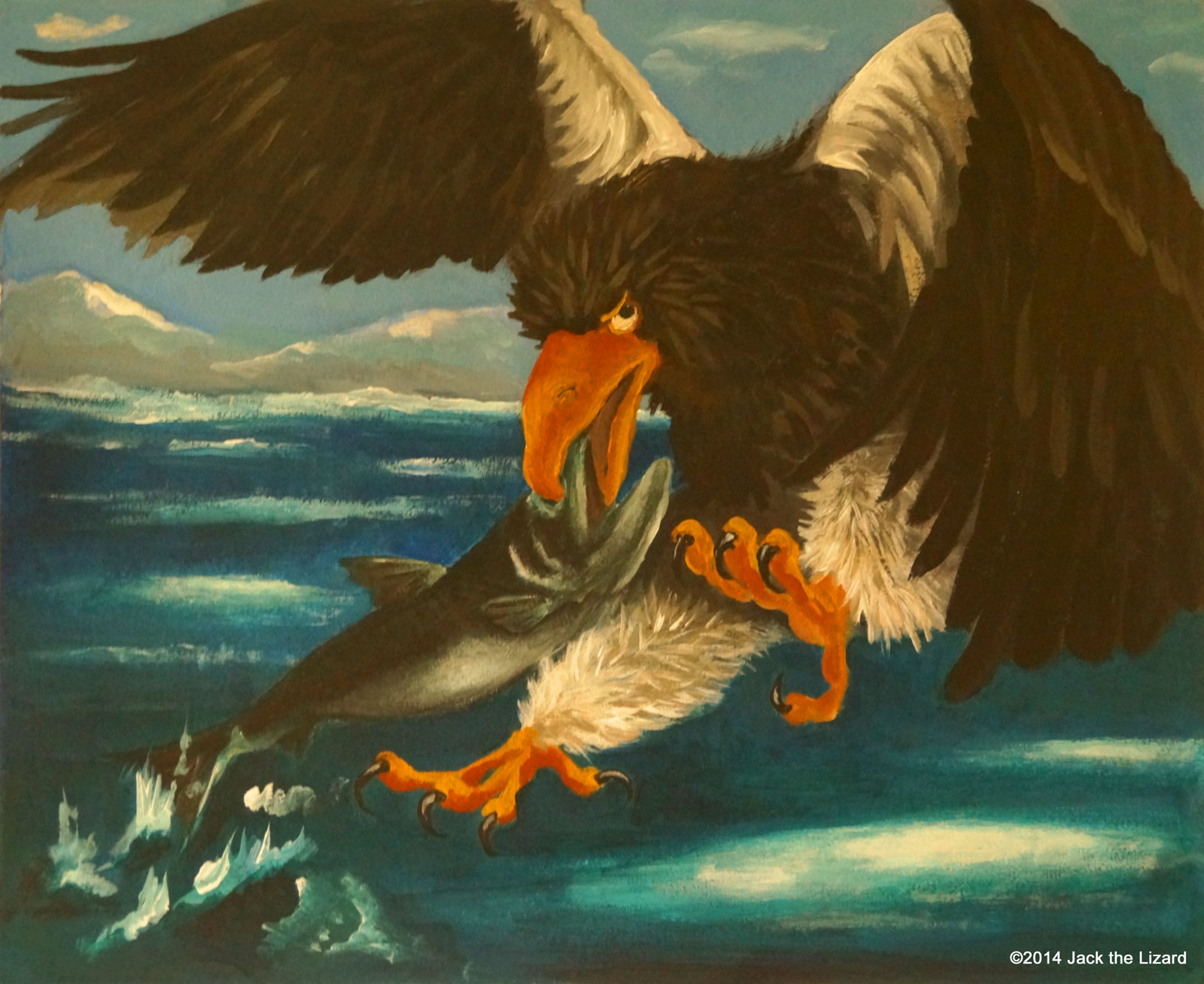
King of Wings - Steller’s Sea Eagle -
|
|
The Steller’s Sea Eagle is the largest raptors in the world, about 33 to 44 in (85 to 105 cm) in length and the wingspan is 6 to 8 ft (2 to 2.5 m). The coast of northern Asia is their range. Not only they have large body but also their beak is huge about 3 in (7.5 cm). Main prey is fish such as salmon, trout, and Alaska Pollock. Steller’s Sea Eagles also hunt water birds such as geese, swans, cranes, herons, and gulls. Foxes and minks are their diet as well. With their size they often have advantage to steal prey from other. Steller’s Sea Eagles migrate from Russia to Hokkaido, Japan during the winter. They stay there from November to March. |
Long leg wild cat in Africa - Serval Cat -
|
|
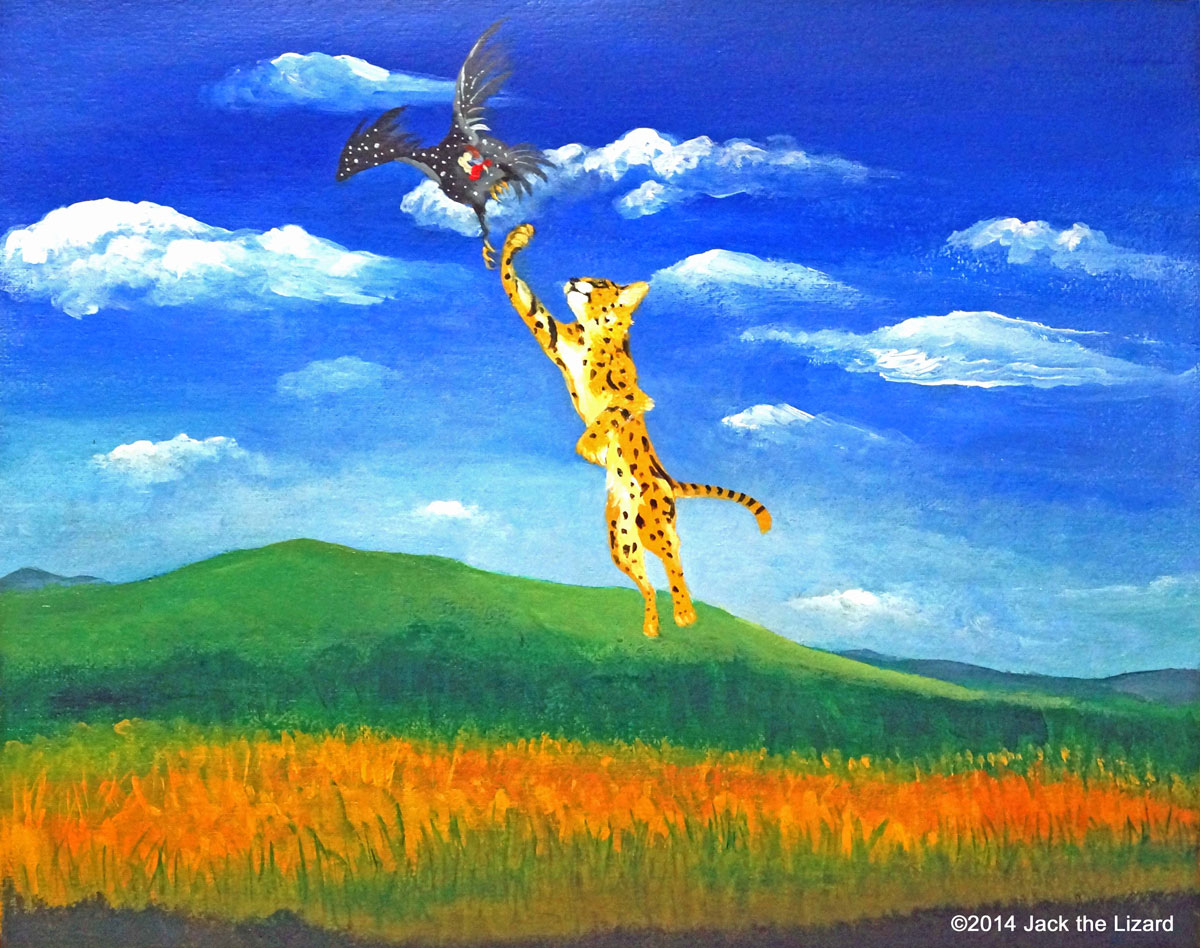
Serval Cats mostly spread their population from central Africa to southern Africa. They live in grassland and riparian forest. They need water, but avoid entering rainforest and dense forest area. The size is about 20 to 35 in (50 cm to 90 cm) without tail and the weight is about 20 to 40 lb (9 to 18 kg) in male. Relative to their body size servals have the longest legs among wild cats and that gives them great mobility and view in tall grasses where prey is hiding. Servals are active during the night and hunting mainly rodents. Their large ears help them detecting accurate location of prey. Various preys are also eaten, such as birds, hares, hyraxes, reptiles, frogs, and even larger animals such as gazelle and springboks. Servals jump high as caracals do, are able to leap vertically about 10 ft (3 m) to seize birds in the air. Catching prey is very difficult for most large cats about 60 % of attempts are failed. Whereas servals are able to kill prey most of times, more than 50 % are successful. The population of servals in the wild is still stable, nevertheless the threats are exist such as hunting for their pelts and losing their habitats as growing human population. |
Crocodile Estivate
|
|
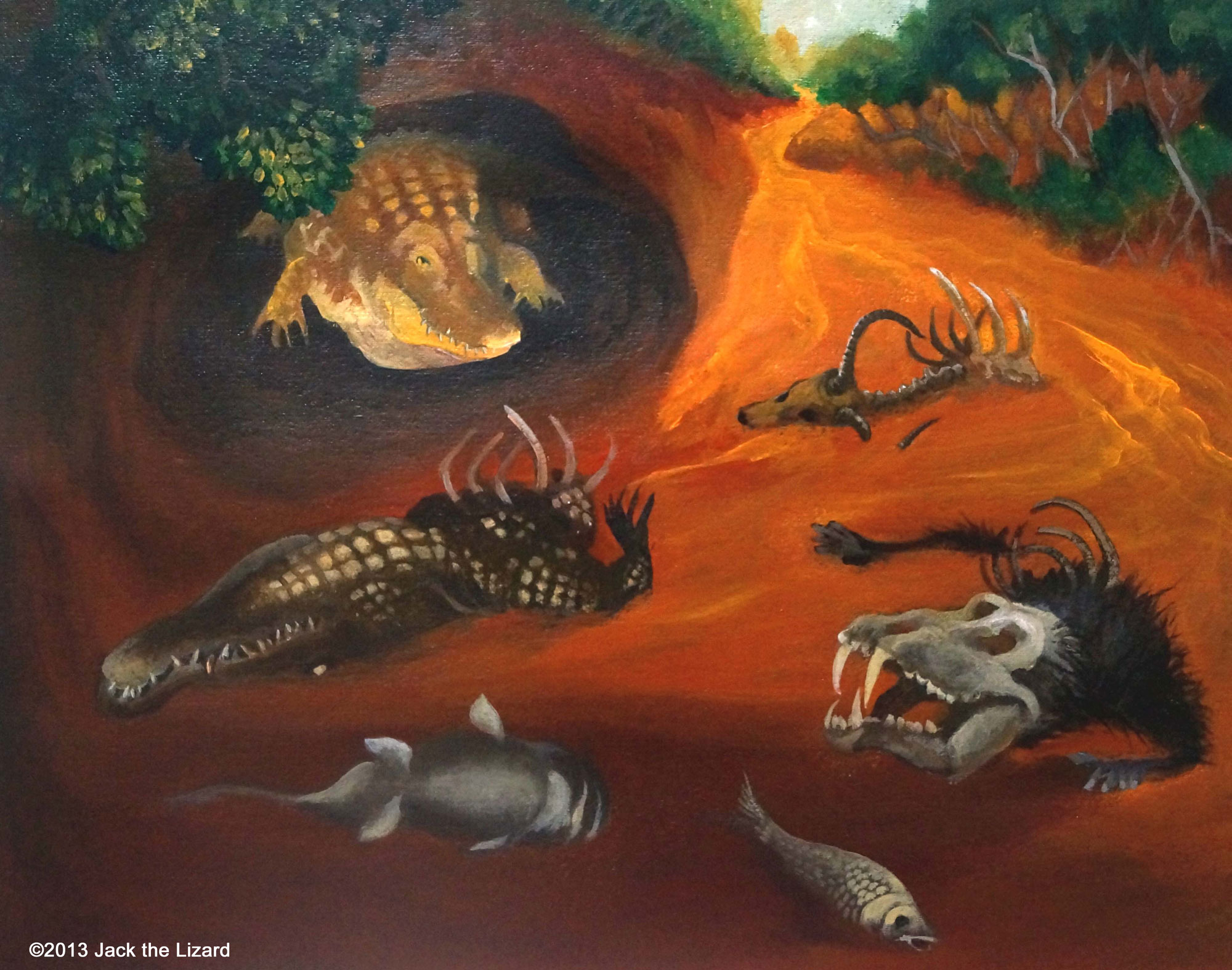
Nile crocodiles are most commonly found crocodiles throughout Africa. They are known as fearsome predator in water and feed on any animal approach, even attack lions when the food is scarce. Despite of being apex predator many of them die in dry season because there are few preys are left and no water in rivers. Even though no water or muds to cover their body left, some of them find a way to adapt to extreme dry environment. They dig burrows on the river bank when plenty of water still flow the river. In addition they have a very slow metabolism so they can endure without food for months. As the heartbeat of crocodile slows down, respiration and blood circulation system slow down. In this way they consume minimum energy inside of their body. Also their stomach acid is the strongest in vertebrate and dissolves even bones and antlers. Few Nile crocodiles live in ephemeral wetlands which are surrounded by desert in Mauritania, Africa. There are no water sources such as rivers and lakes nearby and those ephemeral wetlands are only fed by occasional rain. During the dry season the wetlands are dried up for 6 to 8 months they estivate in caves and burrows. They do not eat and come out during the night sometimes from their refugee den. The local people are never attacked by them and even the local people protect and worship them. |
Tiger fear nobody but Dhole
|
|
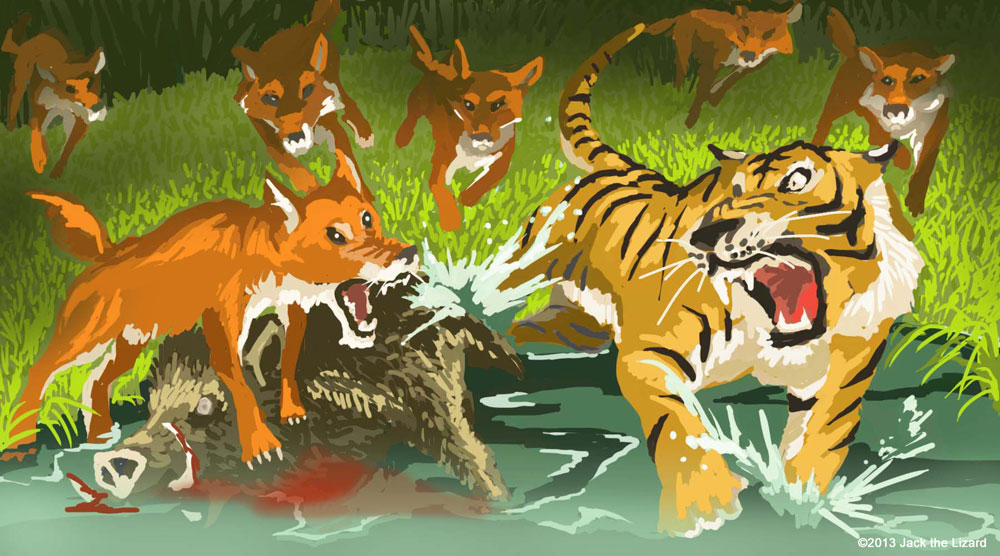
Dholes or Asiatic Wild dogs live in India. Although they usually stay in forest, they are able to extend their habitat to open land. Like African wild dogs Dholes form clans and hunt prey in packs. Whereas their prey is usually medium size animals, they are capable of hunting down large fearsome prey such as wild boar and water buffalo. Dholes usually hunt prey animals in the early morning, not in the night. During the hunting dholes often drive their prey into water to immobilize it. When dholes successfully kill prey, unlike wolves adults let pups eat first. They also eat fruits and vegetable. Similar to African wild dogs Dholes do not attack human. Tigers and leopards share the land with dholes. Since their prey size is different, they usually do not compete between each other over prey. Even if that is occurred the pack of dhole can defend their kill off them or rarely even attack a tiger. |
Chicken can cry
|
|
 Jack the Lizard |
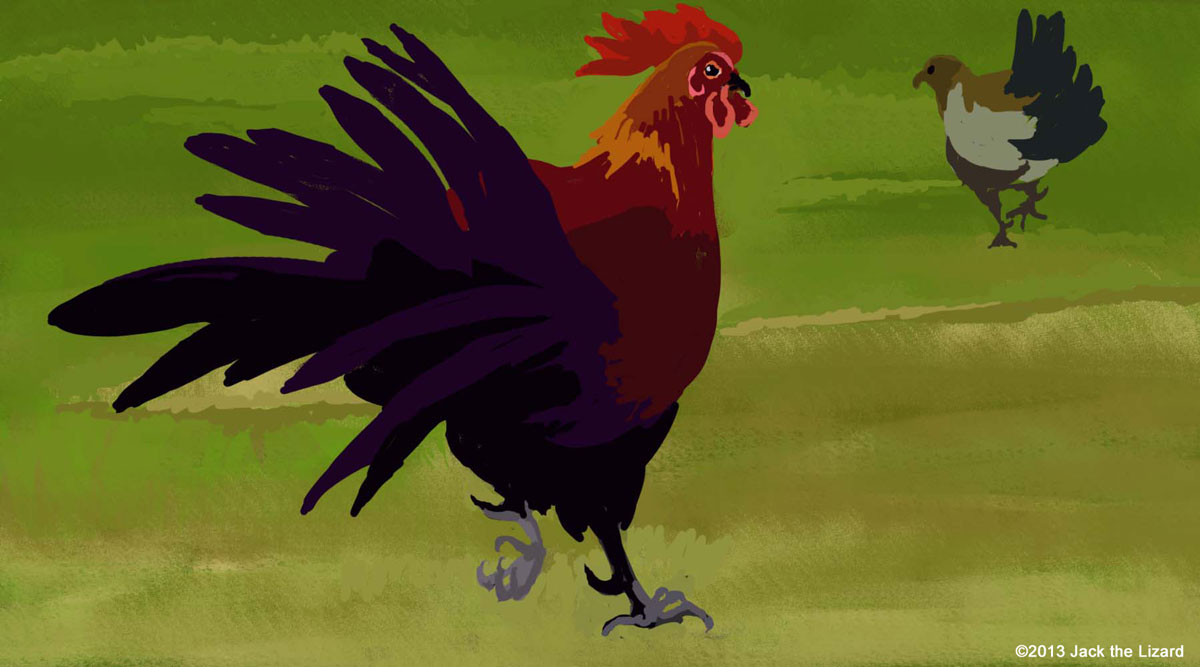
Chickens have lived with humans for about 5000 years. Probably their ancestor was the bird called red junglefowl who were from the forest of South east, East, and South Asia. Yes, they were once wild birds like eagles and geese. Red junglefowl still live in their original habitats, India and other places today. Adult male chickens are called cocks or rooster and females are called hens. They were domesticated for meat and eggs. Especially broilers are the chickens that bred and raised for meat products. Past fifty years broilers have been increased their weight rapidly to produce more meat per animal. Then broilers developed health problems because they are too heavy to sustain their own weight. Poor rearing condition also weakens their immune system. Not only broilers have problems but also commercially farmed chickens for eggs are treated poorly. To solve these problems European Union and U.S. government start introducing regulations for animal welfare. |
Shark Impact
|
|
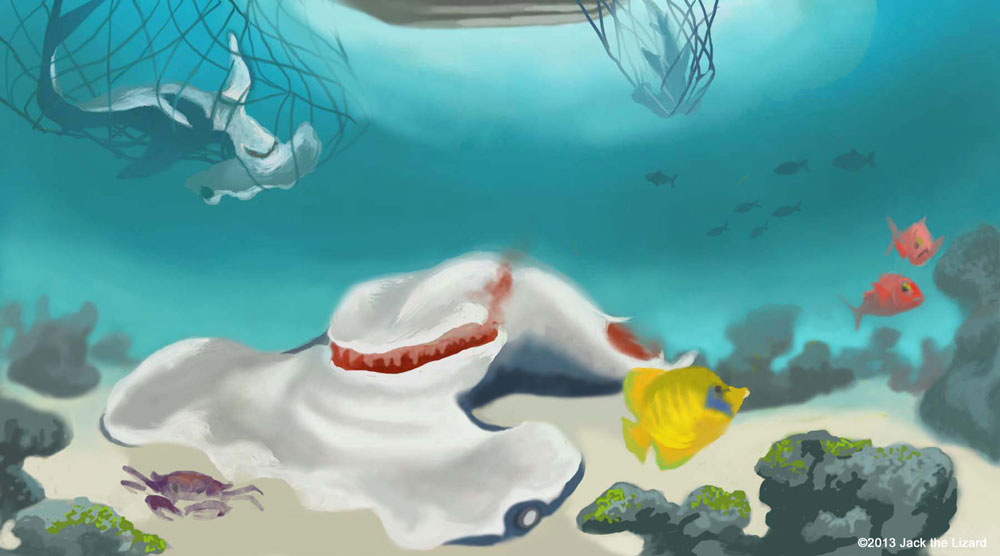
Since most sharks are not able to grow rapidly, they are vulnerable to overfishing. For example the scalloped hammerhead shark takes approximately 16 years to mature and the sandbar shark takes about 25 years to become sexually mature. Recent studies show that 90% of shark population may be depleted across the world’s oceans because of uncontrolled fishing. Sharks are hunted for their fins only because their fins are ingredients for Chinese soup. Most of the time their fins are cut off on the ships and bodies are thrown away to the sea. As most of shark species are economically low value, by catch-sharks are discarded as well. There was the symbolic incident in the North east coast of U.S.A. After the population of shark species preying on cownose rays decreased, the population of the rays exploded. Then the rays gobbled up bay scallops around North Carolina. Consequently the fishery which has 100―year history for bay scallops was closed down. The cownose ray eats not only scallops but also other shellfish such as oysters and clams. Sharks are apex predator therefore they must be protected in order to maintain healthy marine ecosystems. The restriction of sharks caught may not guarantee the recovery of their population. Since coastal zones are nursery places for some shark species, the environment of those places should be stable for juvenile sharks to grow. However increasing human population along the inshore zone leads degradation of the habitats condition. |

People still have hope - Japanese River Otter -
|
|
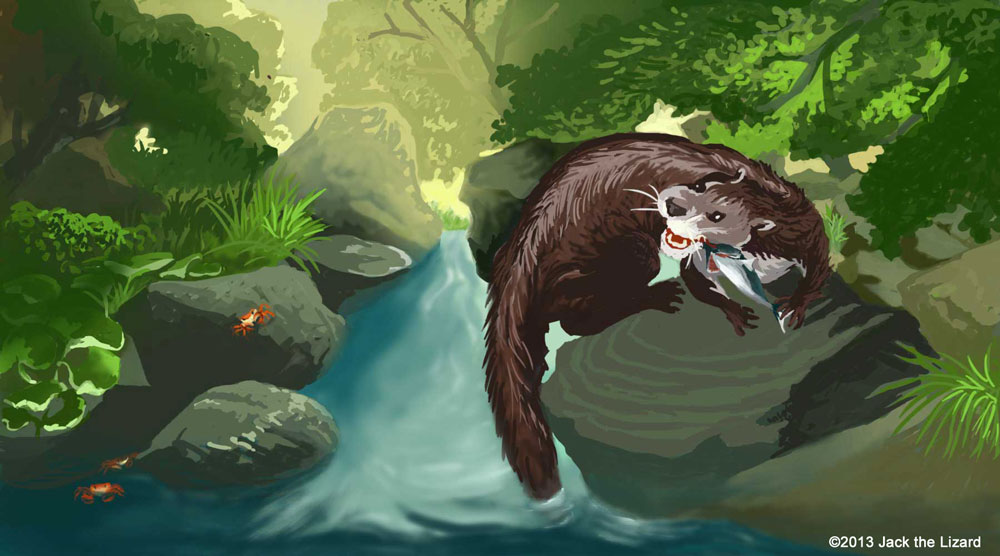
Japanese river otters were extinct species. In 1868 they were even found in Arakawa river which run through Tokyo. They disappeared rapidly from most of rivers and marshes in Japan after the restoration occurred in 1867. Only safe heaven they could find was Shikoku Island. Nevertheless their population continued to decline even in Shikoku because of their fur. A female caught in 1975 became probably the last one. The tragedy of Japanese river otter was mostly related to human activities such as developments of river banks and pesticides for agriculture that caused degradation of their habitats. They were also over hunted and sometimes killed intentionally because they interfered with river fishery. In 1964 Japanese government designated them as a natural monument, but it was too late. Although last year the Ministry of the Environment finally declared the extinction of Japanese river otters locals of Ehime prefecture still believe existence of them. Ehime is located in Shikoku and the region the last one was caught. Since last august several of them have been observed at the beaches in southern and central Ehime. Local government will start the research on the excrement and the foot prints left. |

Red devil invading north - Humboldt Squid -
|
|
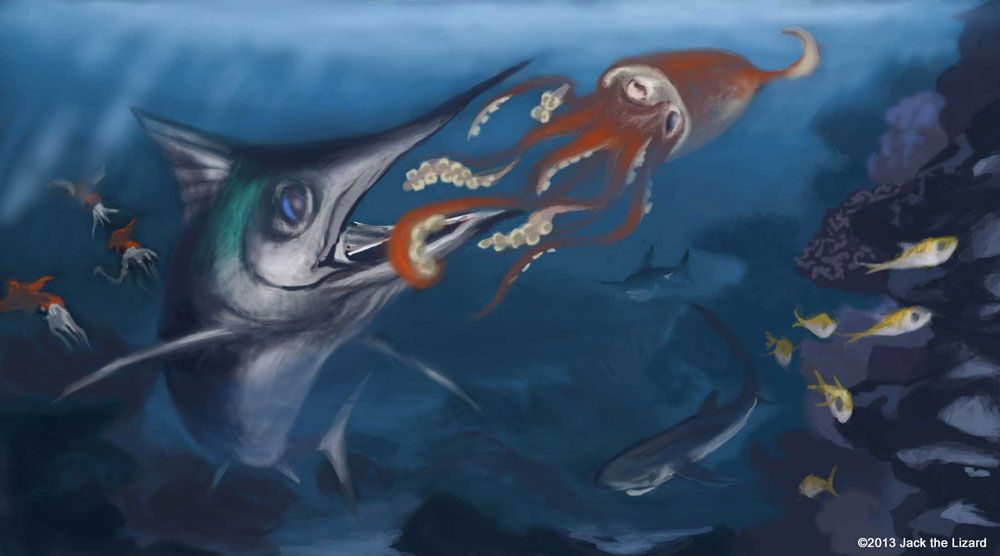
Historically Humboldt squids inhabit off the west coast of South America, but now they expand their range to the north as far as the coasts of Alaska. Exact cause of their expansion is not determined, but warming ocean and overfishing are suspected. The predator such as sharks, sword fish and marlins prey on Humboldt squids. Those fish are also heavily fished. Also Humboldt squids are formidable predator themselves. They hunt small fish in school. Since their aggressive behavior toward fishermen, local fishermen in South America called them, the diabolo rojo means “red devil”. North bound expansion may lead the competition between fishermen and Humboldt squids over fish in California. The size of Humboldt squids is also impressive, grow up to 6 feet long (1.8m) and gain 100 pounds (45kg) within a year. Their lifespan is about a year, but their voracious appetite needs certain amount of prey. Since Humboldt squids usually swim in deep sea, between 660 to 2300 feet, their total population size and reproduction cycle are still unknown. |
Super cleaner - Vulture -
|
|
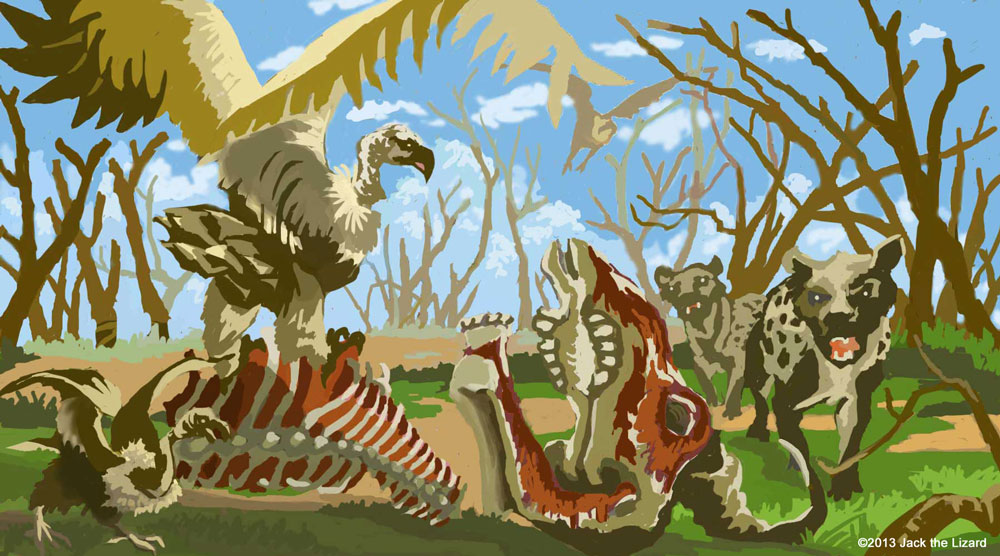
Vultures are scavengers. Therefore they seldom hunt healthy animals instead they find carcasses or wait for weak animals become dead. Several kinds of bacteria in rotten meat could kill off the other scavengers but Vultures. Since vultures have strong stomach acid, they can digest contaminated meat without risk. Therefore ground condition could be degraded if vultures do not clean up body of dead animals first. Small scavengers such as rats and dogs may increase their numbers if vultures were extinct. Since those small animals are carriers of disease such as rabies and canine, they spread diseases among animals. The crops of human could be suffered because increased rat population affect the amount of production. Vultures do important work in nature even they do not charge any. |
Biggest mammal baby - Blue Whale -
|
|
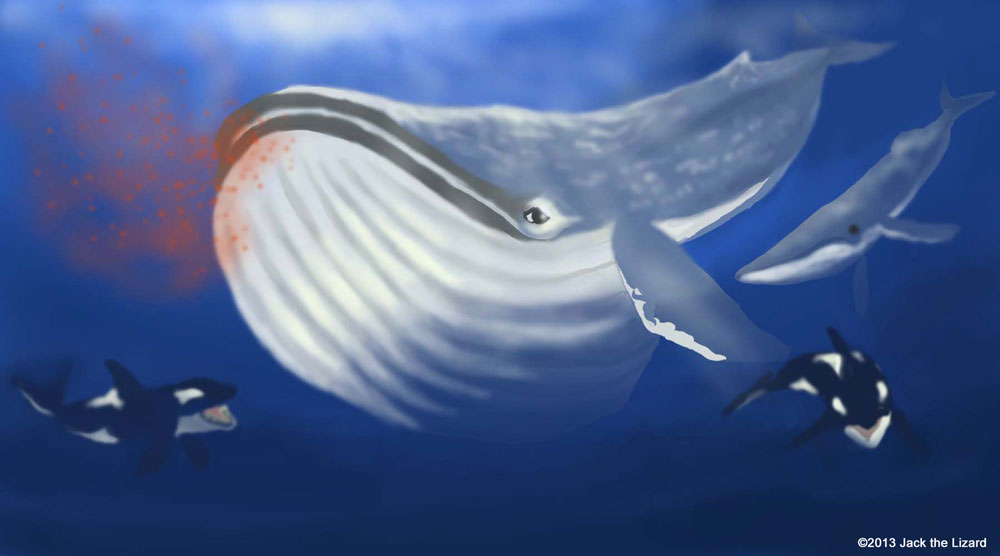
Mother blue whale fills her mouth with krill which is tiny shrimp like crustacean. Blue whales are the largest living mammal on Earth, growing to be 98ft (30m) long, while even babies can approach 25ft (8m) long when they come out from their mother. Comparing to adult male killer whales whose measurement is from 20 to 26ft (6 to 8m) long baby blue whales are enormous in size already. In spite of their gigantic size, krill occupies most of blue whales’ diet. A blue whale gulps in 4 to 6 tons of krill every day. On the other hand baby blue whales feed on mother’s milk only until they reach the age of 6 months old. A baby gobbles up about 50 gallons (189L) of milk in a day and gains 200 pounds (91kg) every day. By examining into their ears we can evaluate blue whales’ age. As a result life span of blue whales is fairly long they live for more than 90 years. |
Terror Big Bird - Southern Cassowary -
|
|
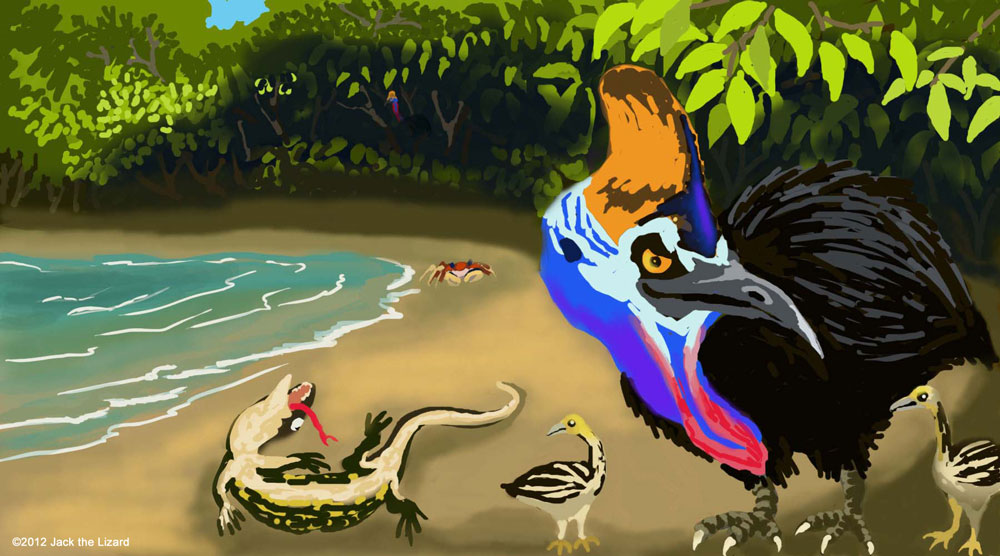
Some flightless large birds such as Moa and elephant bird are already extinct, but others such as ostrich, emu and cassowary still survive today. Southern Cassowaries live in the tropical forest of Indonesia, New Guinea and Australia. They are the third largest birds after ostrich and emu, about 75in (190m) tall. Although they are omnivores, they mainly eat fruits. They also feed on shoots, grasses, and mushrooms. Not only plants and mushrooms but insects, snails, frogs and lizards are included in their meal. Like most of the other flightless birds do, male cassowaries take care of eggs and their babies. After the female laid three to five eggs, she left them behind. Then male incubates their eggs and raises babies all by himself for about 60 days. Father protects and teaches his youngsters where and what to eat for about 16 months. Then young cassowaries live life on their own. Southern Cassowaries have sharp claws on their three toes. With those weapons they are capable of giving serious damage to the opponents such as wild dogs and monitor lizards. Southern Cassowaries have important roles in the tropical rainforest. They eat so many kinds of fruits flesh but not seeds. Seeds are able to pass through their digestive system and dropped off to the ground. Some seeds have to be eaten by Southern Cassowaries to grow. Over 100 species of plants needs southern cassowaries to disperse their seeds. |
Chase is On - African wild dog -
|
|
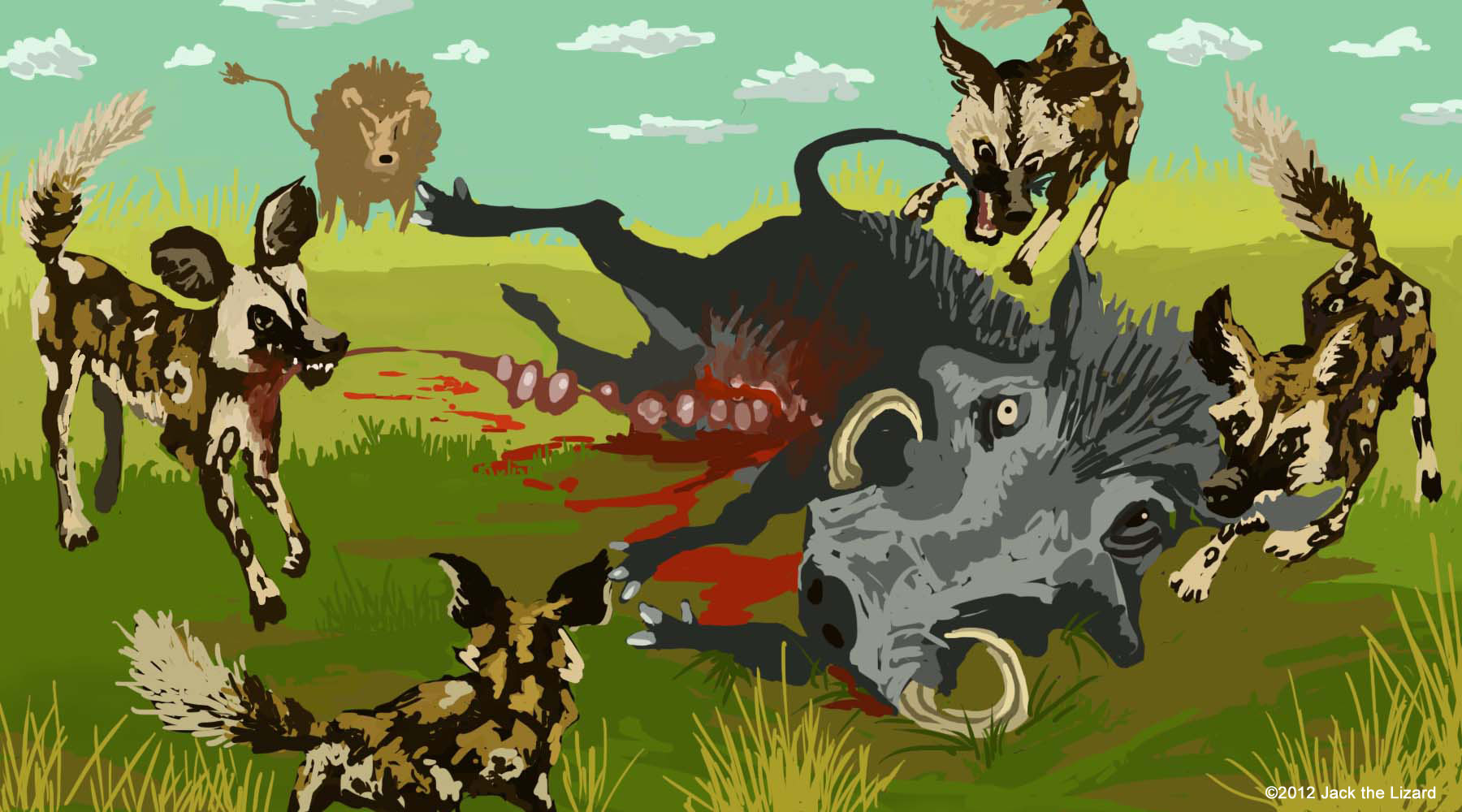
African wild dogs or lycaons live in packs of 5 to 20 and hunt together. African wild dogs are cursorial hunters such as cheetahs and grey wolves. This means that they are adapted to long-distance high speed chase. To organize efficient pursuit they use their voice. Nearly 90 % of their hunting is ended successfully. The prey are medium size animals such as impala, Thomson’s gazelle and spring bog. They also hunt large size prey such as zebras, warthogs and wildebeests. Often time their hunting style looks very cruel, because they cut their prey’s belly and pull bowels out. In this way prey breed to death, but it is quicker way to kill than the other predator’s way. African wild dogs share their meat with the pups and the old, sick or injured members who watch over the pups at the den. Lions and spotted hyenas steal prey from African wild dogs and if lions had a chance, they kill off all dogs and pups. Ranchers and farmers also persecute the dogs because some dogs are threats for their live stocks. Other threats for the dogs are diseases such as distemper and rabies. African wild dogs live in small part of Central and Southern Africa. |
Diving Lizard - Marine Iguana -
|
|
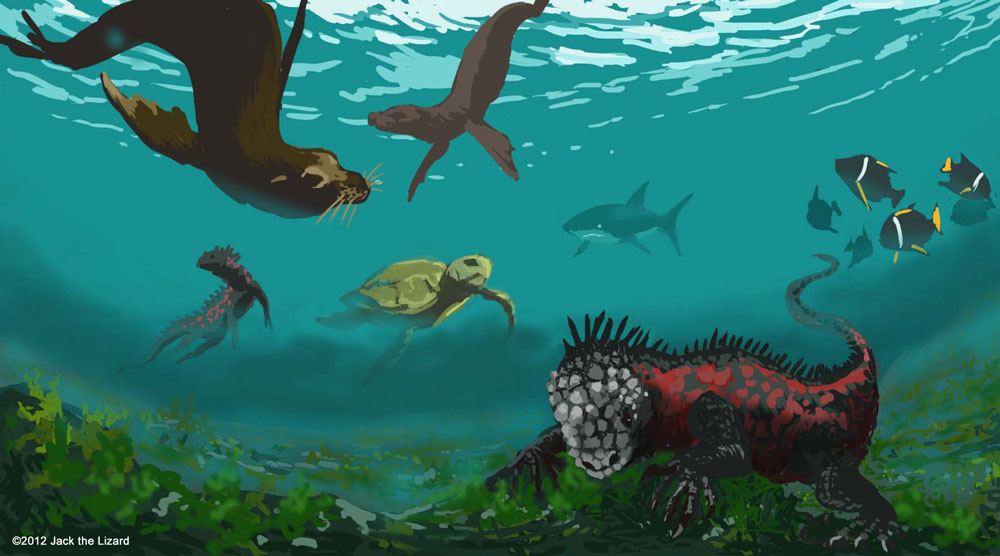
Marine reptiles had appeared in the early Permian period, the end of Paleozoic era and most of them had gone extinct in the late Cretaceous period during the Mesozoic era. Now only few species are left such as the family of sea turtles, the family of sea snakes, salt water crocodiles and marine iguana. Marine iguanas live in the Galapagos Islands, Ecuador. The size is about 5.6ft (1.7m) in length and the weight is about 3.3lb (1.5kg). Usually they bask on the rocks or beaches near shore to heat up their body. When they feed on their staple food such as algae and seaweed, they dive to a depth of 13 to 16ft (4 to 5m) and stay in water about 15 to 20 minutes. They are good at swimming and their body is thinner compare to the other iguanas like fish. Their claws can grip the rocks firmly not to wash themselves away by strong currents. They can also throw excessive salt out through nasal gland. During the mating season male iguanas turn their body color from black to pink, dark brick and several green. Sharks feed on marine iguanas sometimes, but the worst night mare for marine iguanas is cold weather. |
Little Impaler - Bull-headed Shrike -
|
|
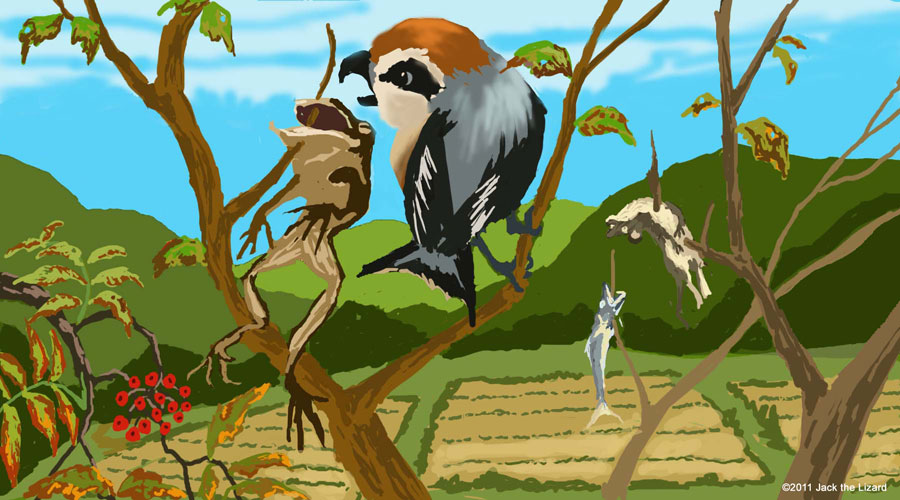
Bull-headed Shrikes live in China, Korea, Japan and Russia. Some migrate to southern China during the winter. They often fly around open field and the edge of forests to look for their prey. The prey is diversified such as insect, fish, amphibian, reptile, and small mammal. They look adorable, but have dreadful habit, impalement. It is not clear why they do that. Some think that they prepare for winter, but they do not always come back. Another say that since they are small and cannot eat whole prey at a time, they come back later. Yet they often forget where they left their prey. Sometimes they killed prey and do not even eat it, they just stick it on the twig and leave. In Japanese this curious behaviour is called “Hayanie”. |
Watch out! They are bug eater
|
|
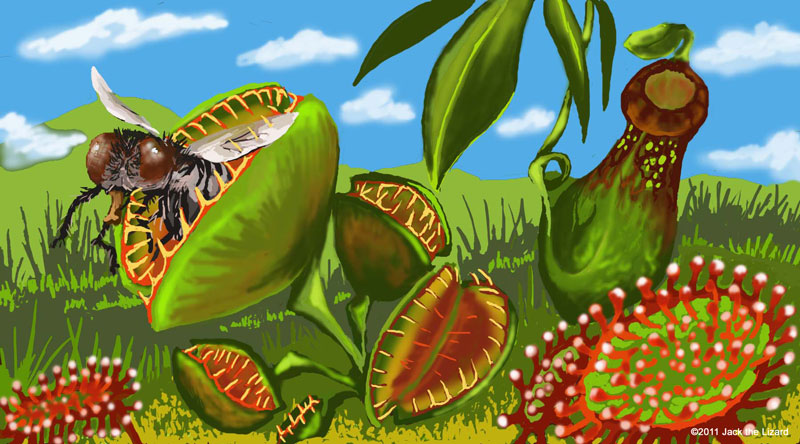
Carnivorous plants eat insects, spiders, crustaceans and invertebrates. They feed on even small lizards, frogs and mice too. To catch prey carnivorous plants use three major techniques. Some species such as round- leaved sundew produces sticky substance with sugary scent on its leaves to attract and capture prey. Others develop their leaves like pots to trap prey insides of them. These pots secrete sweet scent and nectar to allure prey into the pots. Pitcher plants have this type of net. Water wheel plants and Venus flytrap bite their prey with their leaves and slowly digest victims in about 10 days. In the wild Venus flytrap is only found in North and South Carolina, U.S.A. All three types of carnivorous plants have brilliant colorful leaves in common. Although carnivorous plants can be found all continents except Antarctica, they live in the places in which nutrients are limited in the soil. While carnivorous plants eat other animals, they also do photosynthesis like other plants do. Therefore they need sunlight and water. One of unique feature of carnivorous plants is special enzyme with which they digest their prey. |
Lions’ Table Manner - Heart, Liver, Kidney...
|
|
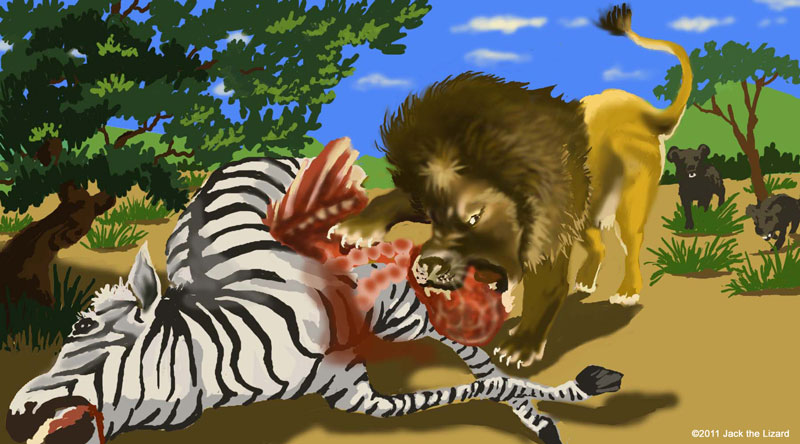
When Lions feed on fresh killed prey, they eat internal organs first. They rip up belly of prey and devour heart, liver, and kidney. They also eat intestine but not stomach. Then the hindquarters of prey are consumed. Finally they eat the ribs and forequarters. Usually the head and spinal column are left behind. The exact reason why they have this eating habit is not known. It may be because internal organs are nutritious part of body. Since Spotted Hyenas can crush bones with their powerful jaws and teeth, they clean the carcass lions left. Alongside of Spotted Hyenas Jackals also feed on anything left over. Following those carnivores Vultures and Marabou Storks start eating carrion. Finally Burying beetles and Flesh flies come in finishing all. |
Ton vs. Ton - Northern Elephant seal -
|
|
|
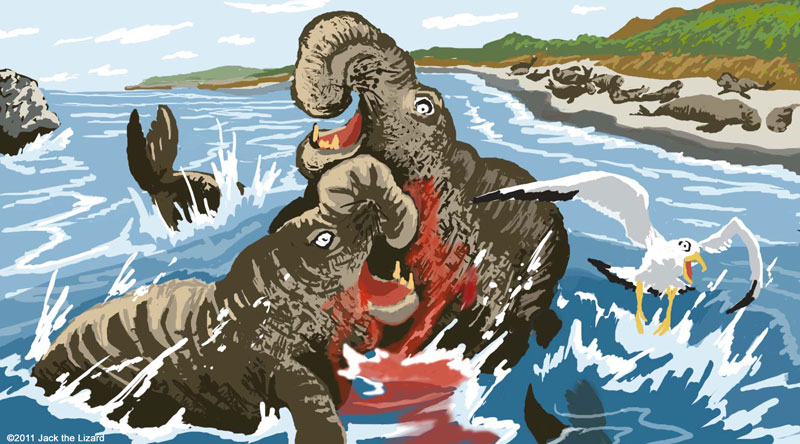
Males fight each other for the position of ruler. Rulers have their harem in which they mate with females. However the way to the ruler is hard. Occasionally one of them loses their lives during the fight.
In winter males arrive at the breeding beaches in south coast of California and northern Mexico. After the battles female arrive and form harem with a dominant male. The harem is composed of 50 to 100 females and each of them gives birth to single pup which has been already in a mother since the preceding season. At birth pups are only about 4ft (1.2m) and weigh about 75lb (35kg). Males grow up to about 13ft (4m) long and weigh nearly 4000lb (2000kg). Females are much smaller, about 10ft (3m) long and 1300lb (600kg) in weight. The diets of Northern Elephant seals are squids, several kinds of fishes such as rockfish, ratfish, sharks and rays. |
Death dance - Stoat -
|
|
|
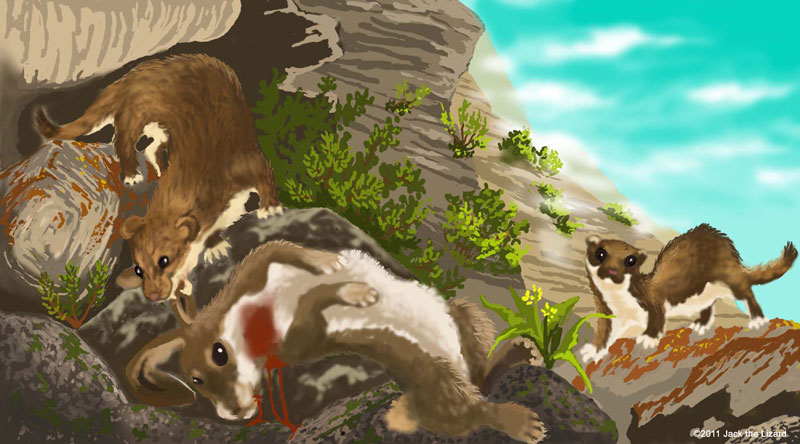
Stoats live in broad regions of the World such as Europe, North America and Asia. The habitats are varied too, marshes, woodlands, mountains and farmlands. They are dwarf predator. The body length is only about 18cm to 32cm (7 to 12in). They look like least weasels, but stoats are little bit larger.
Stoats prey on the various small animals such as voles, shrews, pikas, birds and fish. Sometimes they hunt prey larger than themselves such as hare and ptarmigan. The hunting technique is very unique. When the Stoat confront prey, it romps around prey as if it is not interested. Then suddenly it pounces on the prey and bites the back of victim’s neck. Some animals such as wild cats, foxes, owls and snakes prey upon stoats. Stoats use the burrows of their prey instead of digging their own burrows. Stoats also store excessive food to eat later. |
There is also Estivation - Desert Hedgehog -
|
|
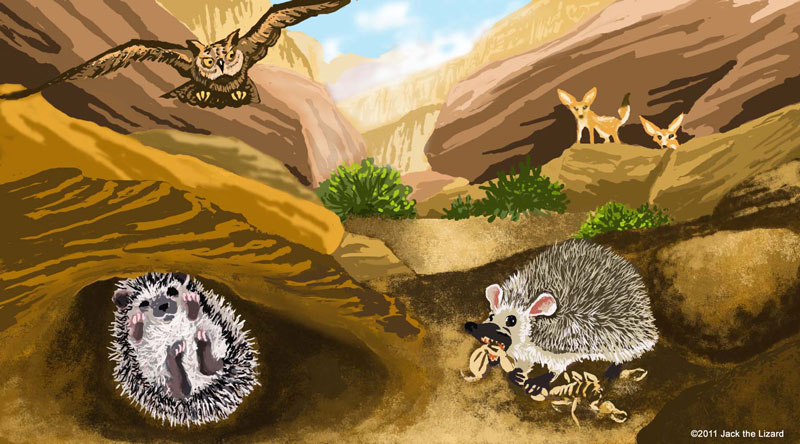
Some animals living in hot and dry places need estivation to escape heat and dehydration. When it is too hot and prey is scarce in desert, Desert hedgehogs estivate in underground burrows or rocks. During estivation their body temperatures get lower and heartbeat get slow to save energy. In contrast to European hedgehog, they do not hibernate because it is not too cold for them to do so in the desert. Desert hedgehogs go hunting during the night. They eat insects, scorpions, spiders and snakes. Their size is about 14 to 28cm (5 to 11in), they are one of the smallest hedgehogs. Desert hedgehogs live in Sahara desert and Arabian Peninsula. Other than desert hedgehogs, some snails, beetles and frogs do estivation. |

Big Bird do not move - Shoebill -
|
|
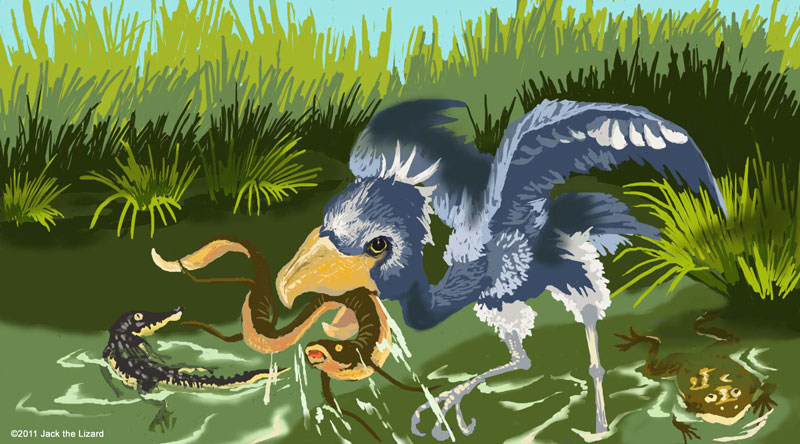
Shoebills live in east Africa from Sudan to Zambia. The habitat is watery places such as swamps and mashes. Stillness is the most important tactics for Shoebills. Since they are very large birds, about 115 to 150cm (45 to 60in) tall, their prey can easy to spot them when they move. That is why they have to wait the moment prey comes around. They hunt aquatic animals such as fish, frogs, turtles and young crocodiles. Especially African lungfish is their regular prey, because it is easy to catch when it comes to the surface to take a breath. |

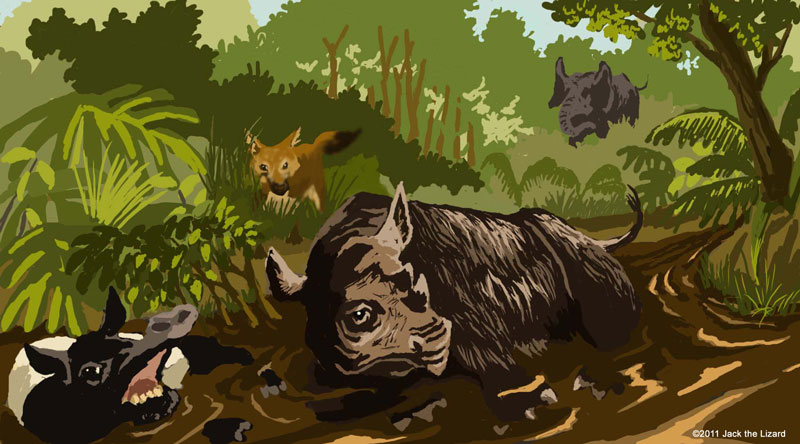
Deep forest wallow - Sumatran Rhinoceros -
|
|
Sumatran rhinoceros are very rare and the smallest rhino in the rhino family. They live in the rain forest of Malaysia and Indonesia. The length of body is about 2 to 3m (6.5 to 9.5ft) and the weight is about 600 to 950kg (1300 to 2000lb). Varying from most other rhinos they have reddish brown hair. It protects skin from insects and cools off their body. They like to splash around in mud during the day. This behavior also keeps their body temperature suitable and helps to avoid parasites. The diet of Sumatran rhinos includes fruits such as mangosteens and wild durian, and plants such as bamboo and Eugenia. They also lick salt to take necessary nutrition. Elephants and tapirs share their natural habitat with Sumatran rhinos. Large mammals like them form trails when they walk around. Other animals such as dholes, boar and deer use those trails too. |
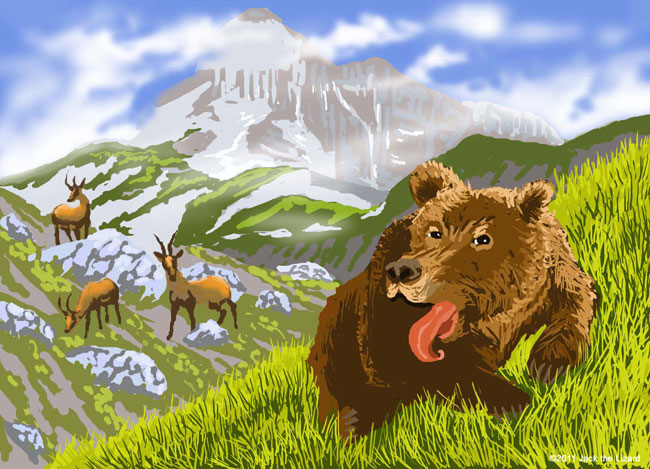
L’Orso Italiano - Marsican Brown Bear -
|
Marsican Brown Bears live in Central Apennine Mountains in Italy, especially in the Abruzzo National Park. They are not large brown bears; a male is about 1.9 m (6.2ft) long and 130kg (290lb) in weight. Usually they are very tranquil and not aggressive. Despite of their popularity only about 50 of them remained because of shrinking habitat and poaching.
Marsican Brown Bears need space to survive. More than 90 % of their diet is plants and fruits, therefore they have to eat a lot to get enough nutrition. They also need the place in which they can hibernate quietly during the winter. |
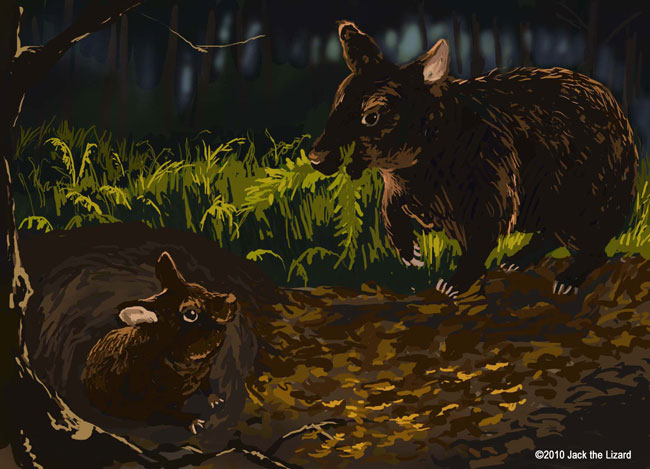
Small islands with jewel - Amami Rabbits -
|
Amami rabbits are very rare rabbits, only found in two small islands Amami Oshima and Toku-no-Sima in Japan. These semi tropical islands are located between Kagoshima prefecture, southern Kyusyu and Okinawa prefecture. They live in forest and rest in tree hollows or caves during the day. They are active in the night and nibble Susuki grass, the bark of Japanese Cedar and fruits. Usually a mother has one or two baby rabbits and digs a hole for rearing.
Amami rabbits make noise or stump with hind legs to communicate. The predator is vipers, dogs, cats and mongooses which are introduced species to kill vipers. Amami rabbits are natural monument species in Japan. |
|
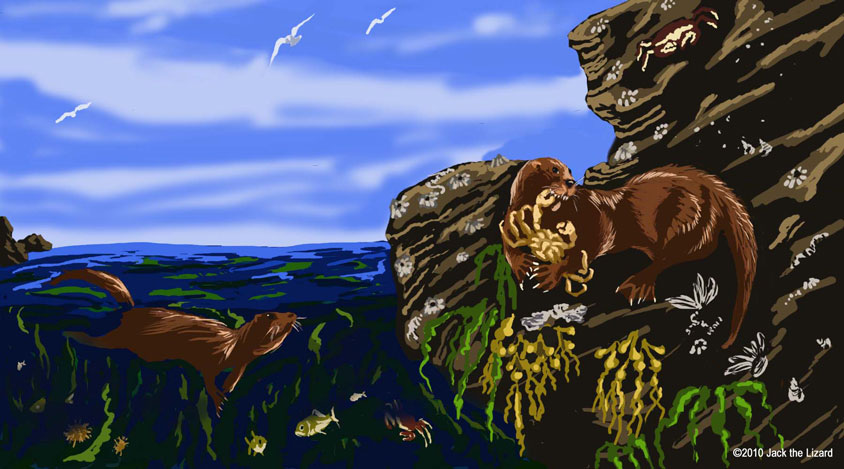
Rare and Elusive - Marine Otter -
|
|
|
They are NOT sea otter! The habitat is the Pacific coast of South America from southern Peru to further north of Argentina. Therefore they are marine mammal, called “Marine otter”.
The size is about 1m (3ft) long and 4.5kg (10lb) in weight. They are active during the day, looking for food such as crabs, shrimps and mollusks. Marine otters are poached for their pelts and threatened by the pollution of shore. The heavy harvesting of kelps is also serious impact on the population of marine otter. As kelps are very important habitat for crabs, shrimps and other marine animals on which marine otters prey. Specialists are trying to confirm how many marine otters still survive and study the effects of harvesting kelps. |
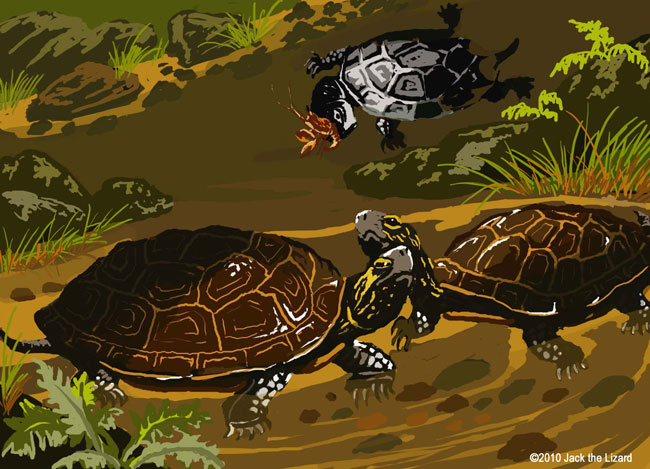
Reaching out softly - Japanese Coin Turtle -
|
The Japanese Coin Turtles or Chinese Pond Turtles occur throughout in Japan except Hokkaido. They are also found in China, Korean peninsula and Taiwan. In Japan their habitats are rivers, ponds and marshes. They also like to stay the man-made environments such as paddy field and shrines in which there are usually ponds. They are omnivore, so eat variety of foods such as small fish, crayfish, clams, water bugs, insects and water plants.
When they start mating, males approach females by extending their necks to females’. After the mating females are laying eggs on the ground from June to August. Some baby turtles hatch out in autumn and others stay in the ground during the winter until spring comes. Adults hibernate when water temperature gets lower. They stay in under water mud or rotten leaves during the hibernation. They usually use lungs to breathe, but when they stay in water they take oxygen through their skin. Female has larger carapace about 30cm (12in) and male has one about 20cm (8in). The life expectancy is subject to conditions, about from 20 to 40 years. Males turn their color almost completely black when they get old. |
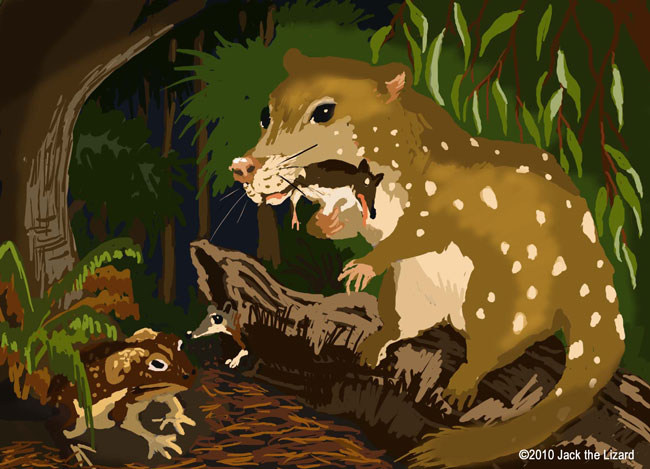
Please do not feed on cane toads - Quoll -
|
Quolls live in Australia and Papua New Guinea. In the Quoll family the following 6 species are identified, New Guinean, Western, Eastern, Northern, Bronze and Tiger Quoll. Tiger Quolls are the largest among them, about 35 to 75 cm (14 to 30 in) in length. Tiger Quolls have white spots on their tails that is distinguishable mark from very similar look Eastern Quolls which have no spots on their tails.
Alongside Tasmanian Devil, Tiger Quolls are the largest carnivorous marsupial in Australia. The prey includes, insects, reptiles, birds and small mammals. The threats to all Quoll species are habitat destruction and predators such as domestic cats, foxes and dingoes. Moreover cane toads are the most serious problem they have been facing on recently. Since cane toads are highly toxic, eating them leads Quolls to almost certain death. So now some Quolls, like Northern Quolls have been trained not to eat cane toads. |
|
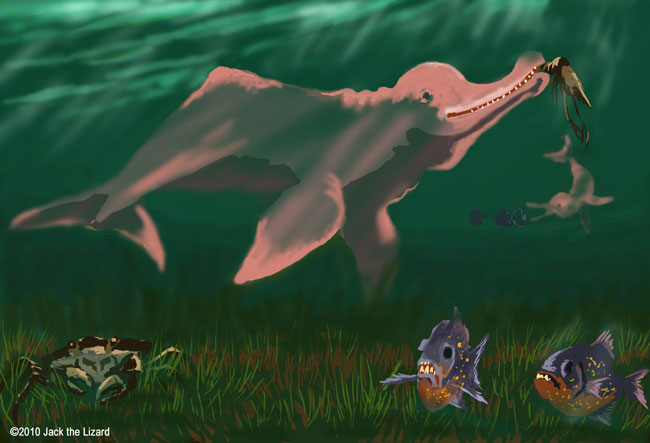
When the Amazon River Dolphin turns pink
|
Juvenile Amazon River Dolphins are grey. Pink is sign of maturity. The color is not only uniqueness of this dolphin. Amazon River Dolphin is also equipped with several sharp senses. One is their sharp eyesight despite the fact that their eyes are very small. The other is that they have the rigid hairs on the beak which spots prey in muddy river beds. They also use sonar in murky waters. The front teeth of Amazon River Dolphins are adapted for seizing prey. The rear teeth are for grinding crabs and small turtles.
Since Amazon River Dolphins have large flippers and flukes but very small dorsal fin, they are very mobile in shallow river waters. |
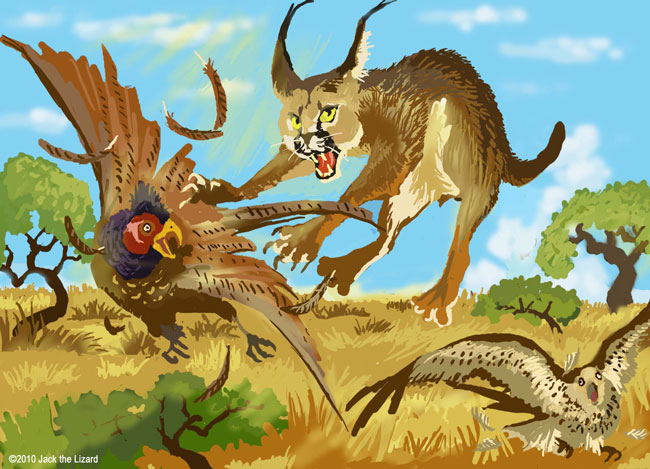
Jump!! Caracal
|
Caracals live in Africa, the Middle East and North West India. Their habitats are the dry woodland, savannah and semi-desert. The length is about 60 to 91 cm (23.5 to 36 in) and 6 to 19 kg (13 to 42 lb) in weight. The lifespan is about 12 years in the wild and 17 years in captivity. The diets are birds, rodents, hares and hyraxes. They remove the skin or the feathers from prey and leave the guts after meal.
They jump amazingly high when they ambush birds. Sometimes the height reaches 3 m (10 ft). Also the power of caracal cannot be underestimated. A caracal is able to knock down the prey larger than itself such as gazelles and small antelope. Despite of fierce appearance caracals can be tamed and in India and Iran help humans to hunt birds. Caracal Movie is here.
|
|
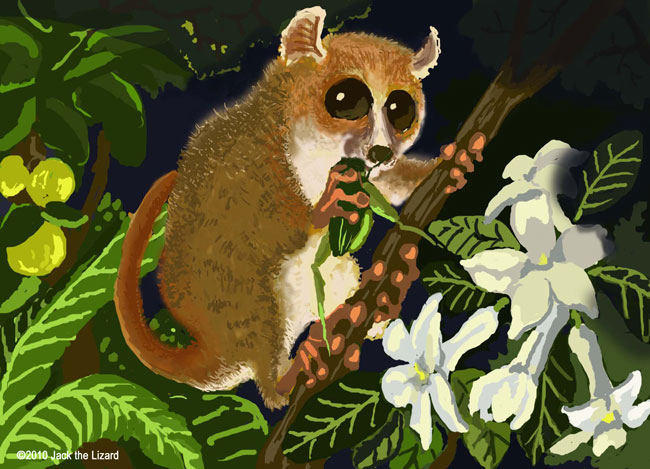
Tiniest digit – Madame Berth’s mouse lemur –
|
Madame Berthe’s mouse lemur is identified as the smallest primate in the world. The body is about 9.2 cm (3.2 in) in length and the weight is about 30 g (1.1 oz). The only home for this lemur is the Menabe region in the island of Madagascar. Madame Berthe’s Mouse lemurs eat variety of food. Fruits and sugary stuff produced by insects are very important diets for them. As nocturnal predators they catch insects and small reptiles in the night. On the other hand the predators of them include civets, mongooses, owls and snakes also on the move during the night.
The reduction of habitat caused by illegal logging and slash-and-burn agriculture threatens survival of Madame Berthe’s mouse lemur. By the way all primates have five fingers with nails like us. They can hold things with hand. The eyes of primates face forward and give them accurate perception of distance. Madame Berthe's mouse lemur Movie is here.
|
Amur Leopards - the Rarest big cat -
|
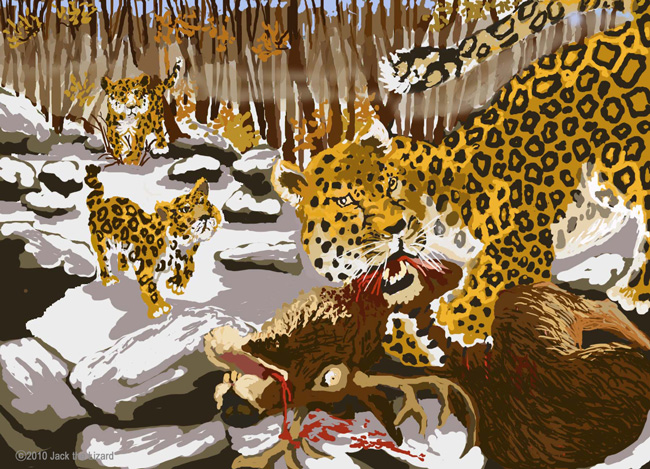
Leopards live in Africa and Asia. Jaguars are not Leopards even though fur patterns resemble each other. About 9 subspecies of leopards are found so far. Some species such as Amur leopard, Java leopard and Arabian leopard will be extinct if we do not protect them. Among those leopards Amur leopards have one of the smallest populations about 30 to 45 left in the wild and 300 in captivity. The main threats are deforestation, poaching (illegal hunting), and inbreeding (few genetic diversity because of small populations). 
Amur leopards inhabit around the borders of three countries, Korea, China and Russia. The length of male is about 2 m (6.4 ft) and 90 kg (200 lb) in weight. In the wild the life span extends up to 15 years and in captivity it may be longer about up to 20 years. The climate in which they spend during the winter is not easy. The temperature drops to minus 56℃( minus 65F). Amur leopards hunt deer, hares (wild rabbits), badgers and rodents. They have thick long tails as snow leopards do to balance themselves while chasing. Certainly you do not need a fridge to keep fresh meat. They keep their left over on trees or under rocks. |
|
Northern idle – Hokkaido Fox –
|
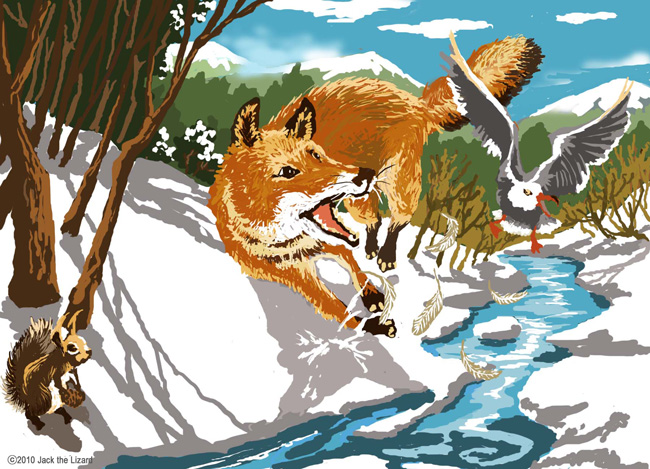
In Japan there are two kinds of fox, The Hondo fox (Vulpes vulpes japonica) and The Hokkaido fox (Vulpes vulpes schrencki). Later is slightly larger and has black spot on the feet and back of the ears. Hokkaido is the second largest island in Japan. The Hokkaido fox inhabits Hokkaido and islands nearby. The Hokkaido fox is about 60~80 cm (23~31 in) in length and weighs about 4~10 kg (9~22 lb). The habitats widely range from coast to subalpine. They hunt rabbits, rodents, small birds and insects. In autumn they also eat some fruits and seeds. 
In early spring pups are born in the den. Basically only the mother takes care of them, but pups' older brothers or sisters help mother sometimes. The father lives alone and does not participate in parenting. In Hokkaido they are one of the most popular animals, but you must not give them food because of the parasite in their body. If other animals including humans were infected, they would die. Surely they are cute, especially in fluffy winter coat though. Hokkaido fox Movie is here.
|
Phantom of Australia - Ghost bats
|
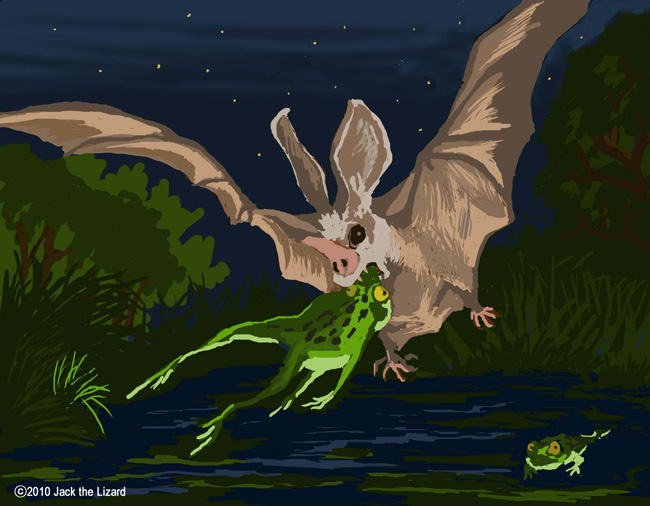
The Ghost bats are Australian. The name comes from the pale appearance in the night. Large ears can hear the sounds a great distance away. They live in caves, cracks in the rocks and abandoned old mines. 
The size is about 10~12 cm (4~5 in). A large variety of prey can be hunted by the ghost bats such as insects, frogs, lizards, birds, small mammals and other bats. They usually hunt within 1 to 2 km of their roost places. They are vulnerable to the destruction of their roost site. Reworking of old mines and cave tourism are some of the reason. |
|
Nobody disturbs Hippo
|
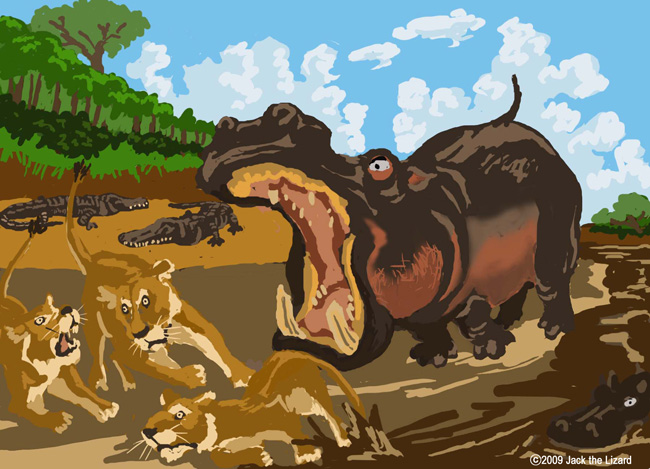
The family of hippopotamus includes two species, the hippopotamus and the pygmy hippopotamus. Both of them live in Africa. The hippos are found in south of the Sahara desert and the pygmies only occur in West Africa. Although the number of the hippo is still stable, the pygmies are threatened by habitat loss through the deforestation. 
The adult male hippo can grow up to about 5 m (17 ft) in length, weighs about 3 tons (9000 lb). The running speed sometimes reached faster than 40 km/h (25 mph). The hippo can run much faster than human. Looks like easy-going creature but once they are disturbed, they turn to be relentless. Especially a mother with calves is dangerous to approach. Since young hippos are vulnerable to Nile crocodiles, lions or hyenas, mother hippo will be very nervous if they are around. One bite of adult hippo is too much for those guys to risk their lives. |
Philippine Eagle - King of birds -
|
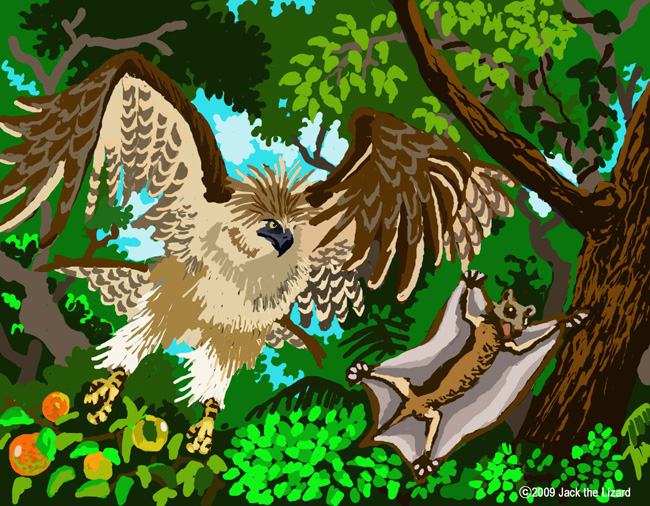
Philippine Eagles can be found on the islands, Mindanao and Luzon in the Philippines. They live in the forest and hunt snakes, palm civet (looks like a cat), hornbills, flying lemurs and monkeys. They are probably the largest bird of prey in the World. The average adult is about 75 to 100 cm (30 to 40 in) tall and the wingspan reaches about 2 m (78 in). 
The nest is built on the giant tree about 30 m (99 ft) above the ground. Parents raise only one chick a year. Only 500 Philippine Eagles remain in the wild and they are critically endangered. The main threat is deforestation as results of logging and expanding of agriculture. |
|
Sometimes the extinction is not forever - Barbary lion -
|
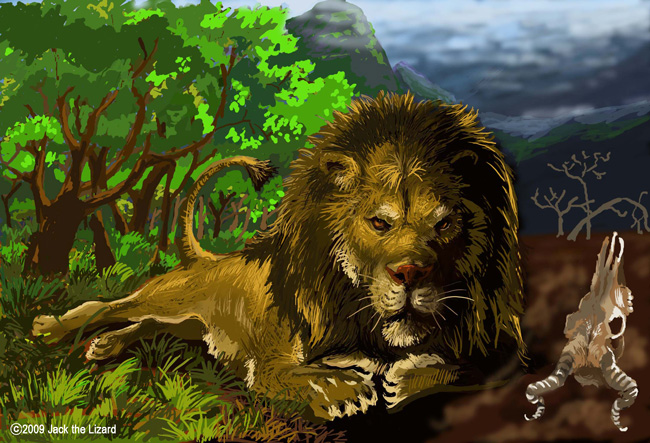
Lions can be divided into about 16 sub-species, but four species of them, European, Spotted, Barbary and Cape are already extinct. Barbary and Cape lions were largest species. Somali lions are the smallest. 
However the extinction is not always absolute. Some Barbary lions have survived in captivity. Several zoos such as Belfast Zoo in Northern Ireland and Hodnin Zoo in the Czech Republic breed Barbary lions and about 100 of them are reared around the World. The long mane which extends chests and belly is the distinguished feature of Barbary lion. The size is about 3.5m (12ft) long and 230kg (550lb) in weight. The natural habitat was the mountain forests of North Africa. |
|
|
Complicated Situations - Crab-eating Macaque |
|
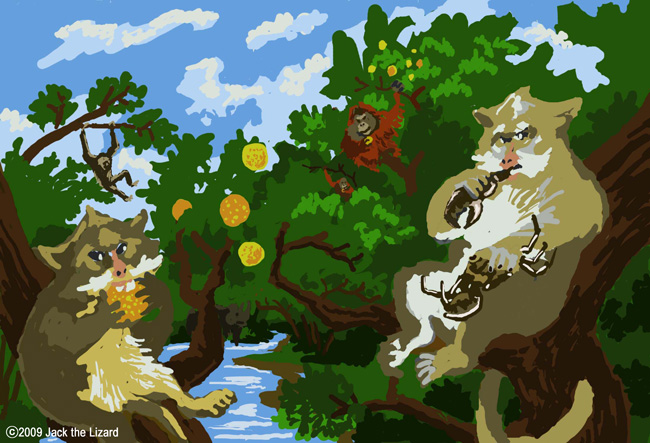
The Crab-eating Macaques live in South East Asia such as Indonesia, Singapore, Malaysia, Thai, the Philippines and so on. The macaques were also brought by people into other places including Hong Kong, New Guinea, Mauritius, and others. Because the Crab-eating Macaque has adapted the new environment to survive, the ecosystems have lost its' balance and the native animals which have not had its' predators in the isolated islands are threaten by the alien macaque. The Crab-eating Macaque looks like a bearded grandpa. It was named the Crab-eating Macaque, but crab is just a part of its diet. The main foods are fruits and seeds. The macaque also eats leaves, frogs, lizards, bird eggs, chicks and so on. The Crab-eating macaques frequently come to the humans' worlds. In Thai and Borneo Island in Indonesia, the macaques are hunted and eaten by human because they damage the grain field. On the other hand in Bali in Indonesia, the Crab-eating Macaque is a sacred animal and lives in temples. For a photo of the Crab-eating Macaque, click HERE ! |
|
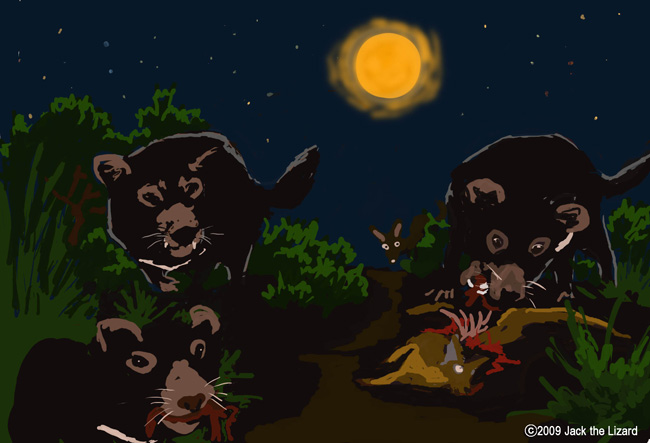
Precious Tasmanian Devil |

|
|
Only found in the island of Tasmania which is located in southeast of Australia. Tasmanian devils are little marsupial. They are only 65 cm (26in) in length and weigh about 12kg (27lb). Females are little smaller. They are like little dogs but powerfully built. The prey is other marsupial such as wombats, wallabies and possums, also birds, reptiles and insect, so they are carnivore. They do both hunting and scavenging. The ability of run fast and the strong sense of smell lead them to the prey. Their strong jaws can crush victims flesh and bones. Now the great danger threats the survival of little guys. The facial cancer, which is only epidemic among devils by biting each other for food, causes the tumor on their face. As the tumor grows, they are not able to hunt and eat. The cancer spreads very fast. The population of devils is dropped significantly. Therefore zoos and conservation organizations catch some healthy devils to protect. Now about 170 of them are in captivity and will be reintroduced in the area, of which free from the disease in future. Although people try hard to find out what causes this cancer, the cause and cure are not found yet. |
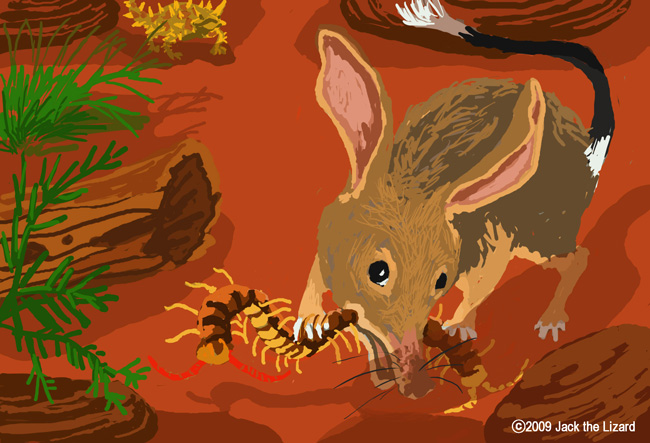
Bilby is not a rabbit
|
Bilbies are Australians who live in dry lands such as the Tanami Desert of Northern Territory, the Gibson Desert of Western Australia and some areas in southwest Queensland. The population of Bilby is declined because of habitats loss and predators such as foxes and cats. Bilby is about 30 to 50 cm (12 to 20 inches) in length and weighs about 1 to 1.5kg (2lb to 3lb). Bilby eats seeds, bulbs, plants, insects and spiders. The moisture in the food gives Bilbies enough water to survive. They are well adapted to arid environment and active in night and rest during day in their burrow to avoid heat. |
|
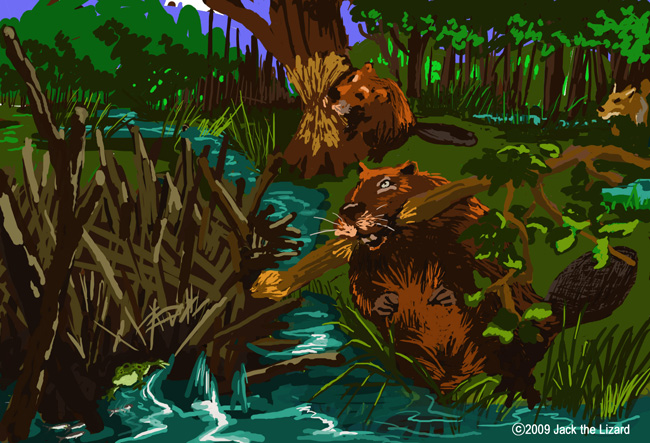
Beaver the Builder |

|
|
There are two kinds of beaver in the world. One is European and another is American. Adult beaver grows up to about 30 inches (80cm) in length and weighs about 55 pounds (25kg). Their lifespan is between 18 and 25 years. Beaver couple lives together. Their diets are the bark of poplar and maple tree. They also eat plants and berries during warm period of a year. Beavers construct the dam and the lodge for their home. First of all they set the timbers up in the stream. Then they fill the gap between the timbers with mud, stones and leaves. Beavers start making their lodge after the dam holds water long enough and creates the ponds. The dome-shaped lodge is made of branches and leaves. It provides the foods and the protection from the predators such as wolves, bobcats and cougars. Since beavers do not hibernate, they can live together comfortably inside of the lodge during the winter. Although the dam is pretty strong enough to hold current, it must be well maintained. To do so, beavers create canals to supply the reinforcement. Beaver dam and lodge also benefit other animals. Frogs and fish can have their hiding place. The canals eventually shape wetland which furnishes the habitat for aquatic insect. |
|
|
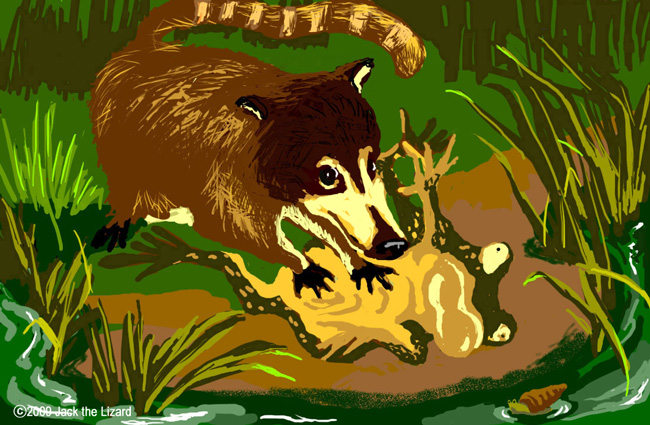
Oh, I know how to deal with it. |
|
Coati is a member of the raccoon family, lives in North, Central and South America. Their sizes are about 30 to 70 cm (about 30 to 27 inches) excluding the tail, weight between 3 to 8 kg (6 to 18 pounds). Females and youths stay together to live, eat and grow their families. Males older 2 years old are solitary most of the time and join the female group for mating. The life span is about 7 to 8 years. Unlike racoons which are active during the night, coati is diurnal. They use their long tails to locate each other in the high bush and weed. Their main diets are insects, fruits, frogs, lizards, rats, and so on. By the way, some toads discharge toxic fluid to scare the enemies off. Unfortunately this weapon does not work for coati. Coati steps on the toed to squeeze the fluid out of its skin before eat it. |
|
Night Hunter |

|
|
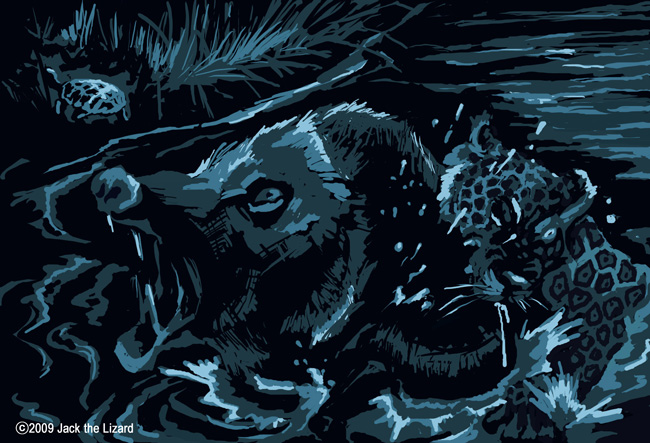
In rainforests the Jaguar eats a variety of prey. From meaty large mammal such as capybara, tapirs and peccaries to carnivorous tough reptiles such as anacondas and caimans whatever the jaguar can find on the dark and humid forest floor. The jaguar hunts small species such as turtles, frogs, and fish. Rainforests are tough places to survive. The jaguar is smaller than the lion and the tiger. The size of body is only about 180cm. The weight is about 160kg. But the power of jaguar is incredible. The jaguar will assault prey in the river or the pond. It is very difficult for the jaguar to get the body out of water because of currents and mud. Jaguar can do that anyway and drag the carcass into the forest to eat it comfortably. |
|
|
Olive Baboon in sorrow |
|
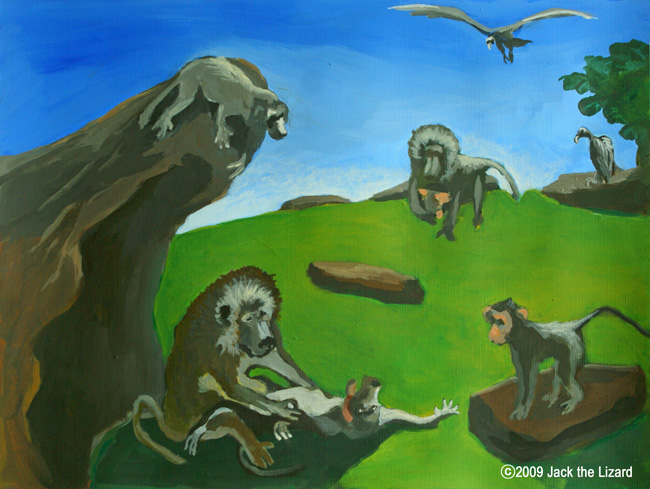
Baboons have 5 species, Hamadryas, Guinea, Yellow, Chacma and Olive. All of them have dog-like faces. They are also closely related to the mandrill which has colorful face. The olive baboon is the most common baboon in Africa. Since they are omnivores, they eat every edible thing such as plants and insects. They are also hunter, so they prey on mammals such as rodents, rabbits and small monkeys. Meanwhile lions and leopards kill olive baboons. Therefore olive baboons always change their sleeping place to avoid those large cats. They are very smart and sometimes cause troubles by eating human crops and garbage. They live in troops. Each troop is composed of 20 to 100 females and their offspring. The bond between mother and their youngsters is very strong. Infants cling to her mother for a year. A mother baboon keeps the body of baby died from disease, injury or starvation for several days. |
|
Run Grey Wolf! Stand still Elk!
|
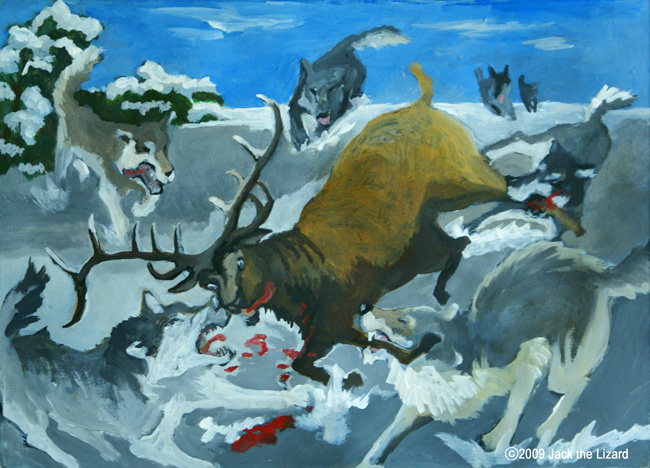
Bull Elk is huge powerful deer, about 400kg (1100lbs), 2.4 m (7feet) long. Male Grey Wolf is about 80kg (175lbs) and 1.5m (60in) long. Usually wolves do not hunt a healthy solid bull elk. They do not want to get hurt with antlers. However when they are extremely hungry and have no other animals to gnaw, they must engage with a Bull. If they can make him run, they will win. Bull would be exhausted himself running. 
|
Sorry, I did not know you are male. Sperm whale
|
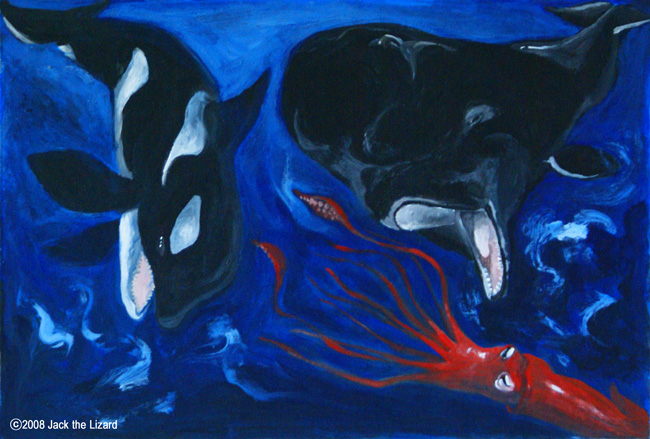
A bull Sperm Whale does not have enemies. Its body reached 20 m in length that is the largest among toothed whales. It is too big and powerful for even Killer Whales to attack. Sperm Whales ate the Colossal Squid. It is known as the largest squid, even bigger than a Giant squid which can grow up to 13m long. A Colossal Squid has sharp hooks on its arms which causes considerable damages to Sperm Whales. 
|
|
For survival why not?
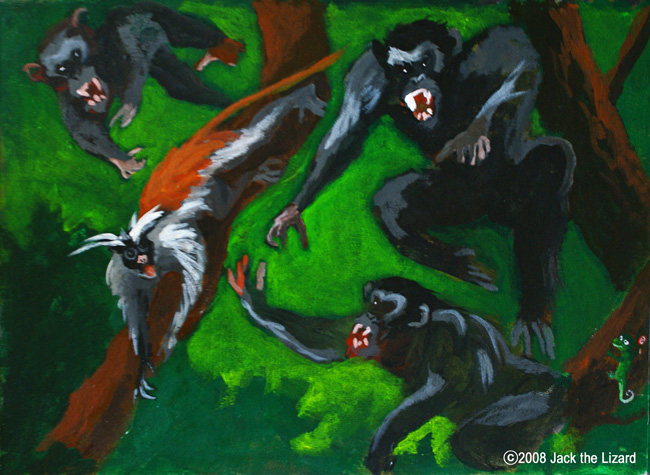
|
Although Chimpanzees mainly eat leaves, nuts and fruits, chimpanzees do hunt and eat meat. According to the study of Kyoto University chimpanzee in Tanzania kill Red Colobus which is about 130 cm long and weigh 5 to 10kg for their meat. They also kill Blue duikers which is 35cm tall and weigh 4kg little antelope and Red tail monkeys. They do hunt both team and individually. While one team chase a prey up on trees, others are waiting a moment a prey down to the ground. Once a prey touched ground, it is doomed. It is rarely witnessed that Chimps scavenge but they eat other animals left over too. The report said that Chimps scavenge the body of Bush back killed by a leopard. Chimps probably scavenge the animals which could not kill by themselves since the prey is too big, weigh about 15kg. 
|
From ants to butterbur
|
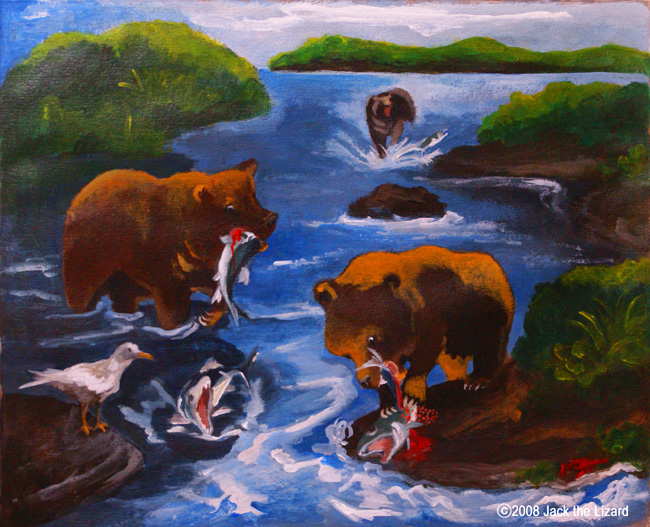
Two anziani had been attacked by bear, north east Japan October 5 2008. One of them was picking up walnuts when she was assaulted from behind. Do not blame on the bear. Probably he was only finding food, and loss of habitat is the most likely reason of his action. This bear was probably a Japanese black bear. Brown bears are also distributed in Hokkaido Island, northern part of Japan. They eat salmon like grizzly bears do in Alaska to accumulate body fat. Whereas they are omnivorous, they eat raspberries, butterbur ants, bees and deer. In fact 80 % of their diet is vegetable. 
|
|
Tiny skilled hunter - Shrew
|
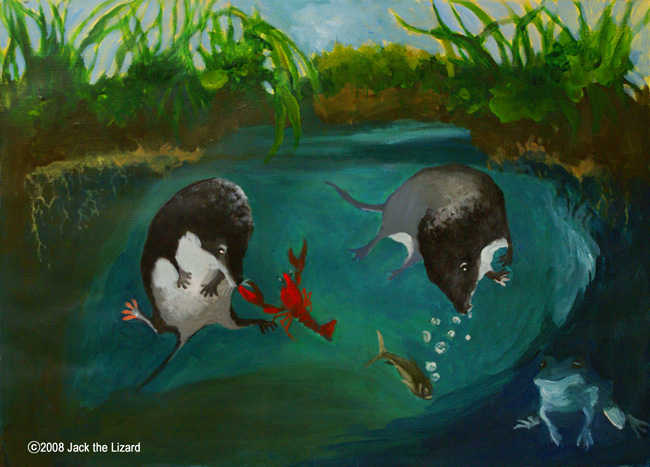
Shrews look like mice but they are not related, not even close. They are more close to moles. Anyway shrews are shrews.
Eurasian water shrews are skilled divers. When they hunt preys in water, they use bubble because their eye sight is quite poor. They brow bubble toward a object and smell the scent of reflecting bubble to recognise the distance and if the target was prey or not.

|
Go Hyena Go!
|
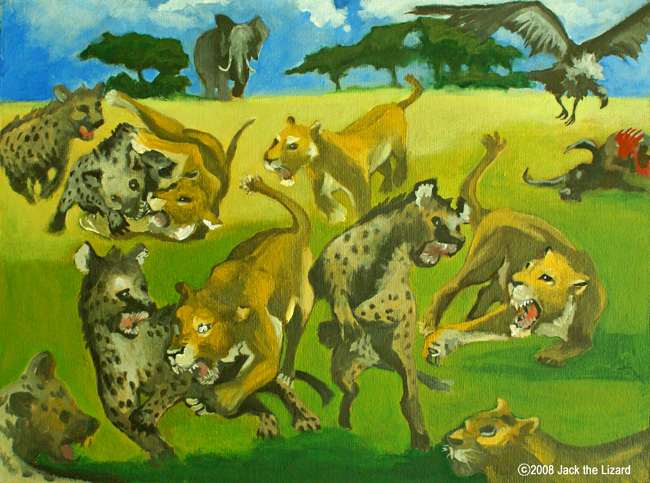
If lionesses are not hungry, this kind of conflict would rarely occur. Although they compete for meat and hate each other, they do not want to hurt themselves during the fight. Simply they cannot afford to take such risks. When the preys are scarce, however this could happen. They are desperately hungry and easily irritate like us. Surprisingly hyenas are tough and consistence. They are raiders of Africa. Go Hyena Go!
|
|
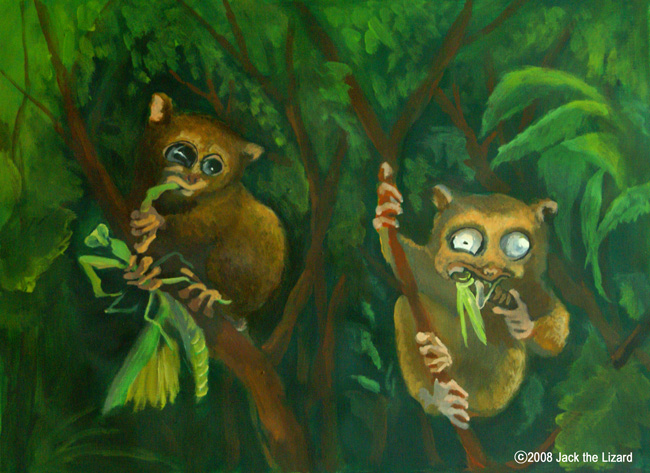
Did Yoda get a tail? No. It’s a Tarsier!
|
The Philippine Tarsier is a tiny primate, whose size is about a banana, 6 inches (15 cm) long. The ancestor of tarsier lived in the Philippines 40 million years ago. Astonishingly tarsier has survived in some of the Philippine islands since then. Tarsier is certainly small but it is very good hunter at night. Tarsier’s big front-faced eyes can measure the distance between itself and the prey very accurately. Tarsier also has very strong hind limb to jump at least 3 meters long between branches. Once tarsier spots a prey, it hits the prey swiftly by using their legs. During the daytime, the Tarsier hides in the hollow to avoid any predators like owls. Tarsier mainly feed insects but also catch small lizards and birds and sometimes even snakes.
|
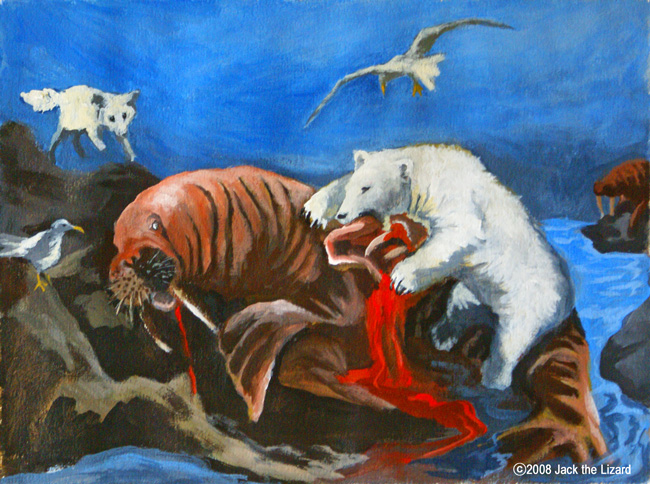
Polar bear and Walrus
|
It is very dangerous for even polar bears to hunt the walrus, but this one is very lucky. He found the carcass of the male walrus, which probably died from injured during the fight against another one. Arctic fox and gulls are also gathering for their share. |
|
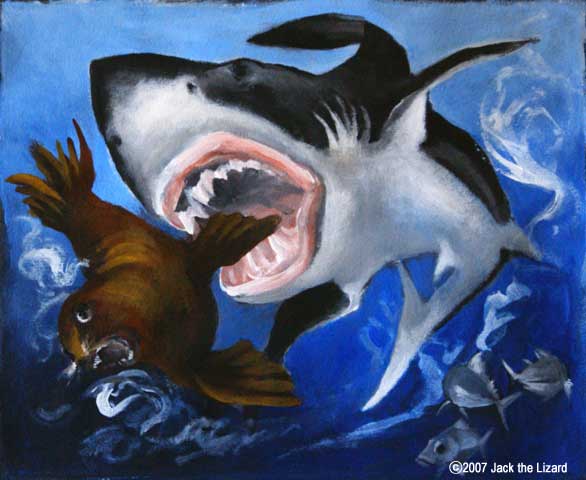
Great White Shark and Fur Seal
|
This is the Great White Shark attacking a Fur Seal. The Great White ambushes the seal from below. The shark prefers the prey with high contents of energy-rich fat. You may be afraid of the shark because of the imange of the man-eater from the Steven Spielberg’s film Jaws. But human is not their favourite food as the body is consist of many bones and little muscle and fat. Now we don't have the accurate statistic of their populations, but the number has been clearly declined. The Great White shark is now on the list of endangered species. They are very curious, and intelligent. Do you believe that they have personality? |
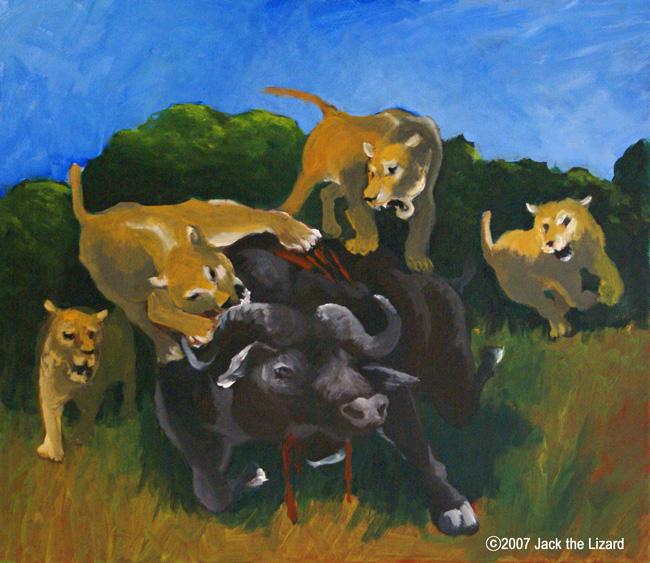
Lions and Buffalo
|
Even if the Lion is the King of Wild, they have to be very careful to hunt an African Buffalo. Its huge horns are strong enough to hurt lions. We sometimes see the buffalo on TV on the Animal Channel or the Discovery Channel, but have we ever see them in a zoo? |
|
Lion and Warthogs
|
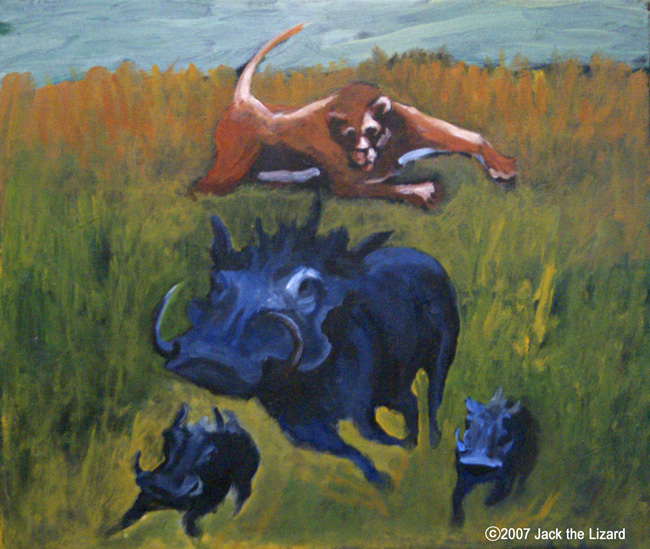
The Lions like to hunt the Warthog cubs because they make such a delicious meal. But even for the Lion, King of the Wild, it is very difficult to catch these elusive little runners. And dangerous too! Just look at those sharp tusks!
|
Lions and Zebras
|
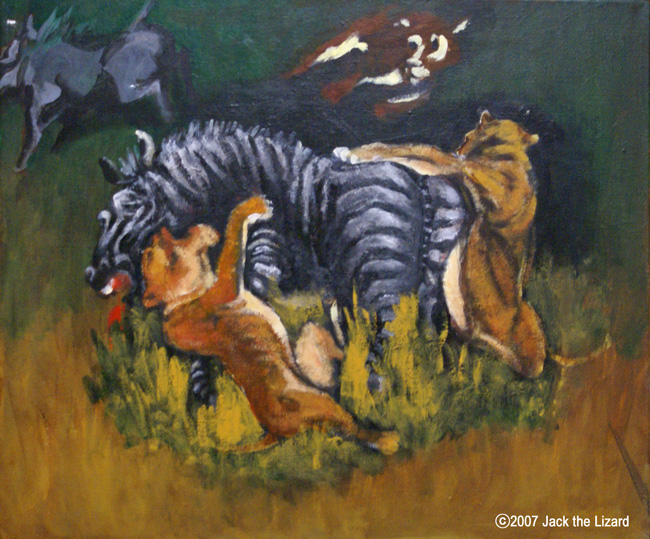
The Lions team up together to capture their prey, just like the wolf packs. To catch a Zebra for example, one group of Lions chases the unsuspecting Zebras towards a second group hiding in the bush ahead. POUNCE! They get him as he runs terrified right into their waiting jaws and claws. He never had a chance.
|
|